
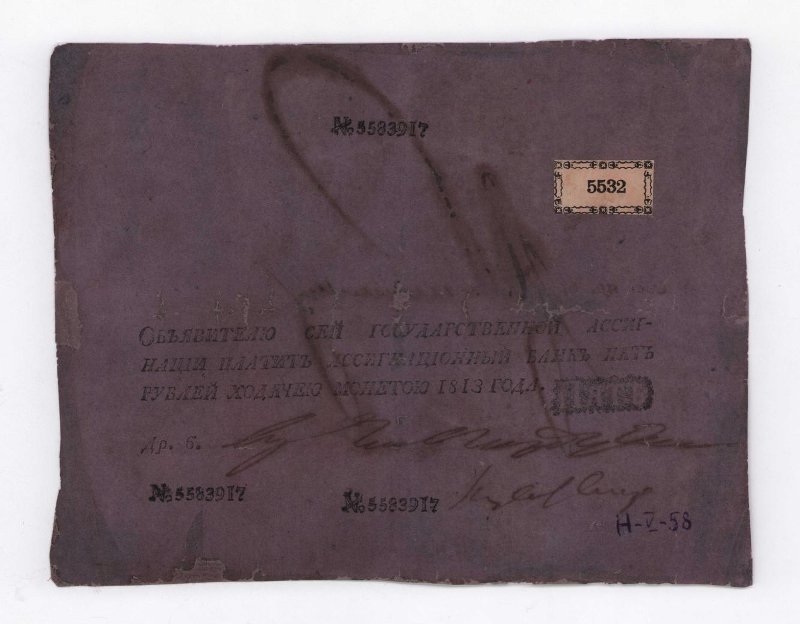
Russian Empire 5 Ruble Assignat, 1813 (1786-1819 Period)
The banknote displays a utilitarian design typical for early assignats, focusing on security features and clear text. The reverse features a central block of text in pre-reform Russian orthography, stating the assignat's value and redemption terms. The paper itself is colored a dark purple/brown, which was characteristic for 5-ruble denominations of this period and served as a basic anti-counterfeiting measure. The overall aesthetic is functional rather than highly decorative.
Description
This is the reverse side of a 5 Ruble State Assignat issued by the Russian Empire in 1813. Assignats were the first paper money used in Russia, introduced in 1769. This particular example belongs to the series issued between 1786 and 1819, a period marked by significant financial challenges for the Russian state, including the Napoleonic Wars. The central inscription, written in pre-reform Russian orthography, states: "ОБЪЯВИТЕЛЮ СЕЙ ГОСУДАРСТВЕННОЙ АССИГНАЦІИ ПЛАТИТЬ АССИГНАЦІОННЫЙ БАНКЪ ПЯТЬ РУБЛЕЙ ХОДЯЧЕЮ МОНЕТОЮ 1813 ГОДА" (The bearer of this state assignat is to be paid by the Assignat Bank FIVE RUBLES IN CIRCULATING COIN OF THE YEAR 1813). This text guarantees the assignat's value against silver coinage of 1813, reflecting the ongoing efforts to stabilize the currency. The assignat features the serial number N° 5583917, printed in several places for security. Multiple handwritten signatures, likely those of bank officials such as the Director and Cashier of the Assignat Bank, are visible at the bottom, though largely illegible due to wear and fading. The dark purple/brown color of the paper was a characteristic feature of 5-ruble assignats of this period, serving as a denomination indicator and a measure against counterfeiting. This banknote is a significant historical artifact, representing a crucial phase in Russian monetary history and the challenges faced during the early 19th century.