
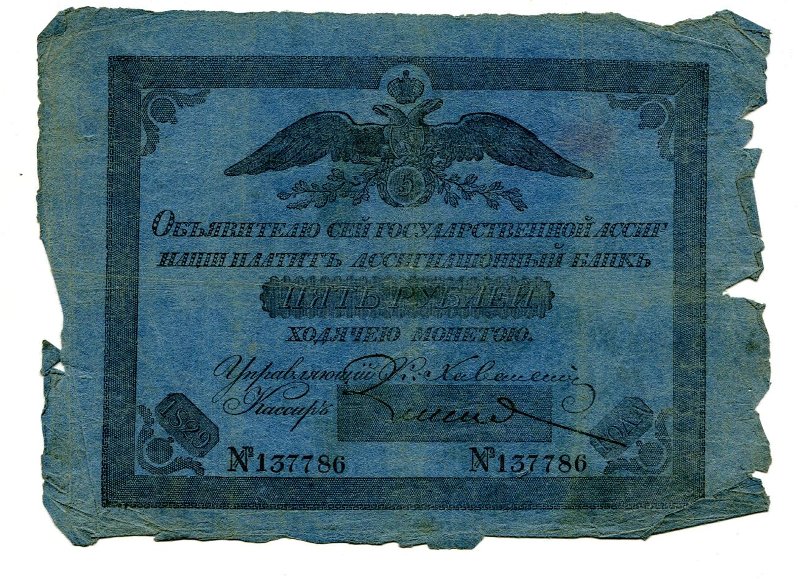
Russian Empire 5 Ruble Assignat, 1822 (1819-1843 Period)
The assignat features a classical design common for the Russian Empire's paper currency of the early 19th century. The central motif is the double-headed imperial eagle crowned, holding a scepter and orb. A circular shield bearing the denomination '5' is placed on its chest, surrounded by a laurel wreath. The main text, 'ОБЪЯВИТЕЛЮ СЕЙ ГОСУДАРСТВЕННОЙ АССИГНАЦIИ НАШЪ ПЛАТИТЪ АССИГНАЦIОННЫЙ БАНКЪ ПЯТЬ РУБЛЕЙ ХОДЯЧЕЮ МОНЕТОЮ,' is printed in a traditional serif font. The borders are simple geometric patterns with floral or scrollwork embellishments in the corners. The entire note is printed in a distinctive blue ink on thin paper, which was characteristic for the 5-ruble denomination of this period.
Description
This is an authentic 5 Ruble assignat issued by the Russian Empire in 1822, belonging to the series issued between 1819 and 1843. Assignats were paper banknotes that circulated alongside metallic currency, introduced to finance state expenditures and facilitate trade. The 1819 decree led to the issuance of new assignats with standardized designs and colors for different denominations (e.g., blue for 5 rubles, green for 10 rubles, etc.). The design features the imperial double-headed eagle, a symbol of Russian statehood, prominently at the top. The text guarantees payment by the Assignation Bank. The specific year '1822' is stamped within an oval cartouche on the lower left side, indicating a particular issue date or series within the broader 1819 type. These notes are significant historical artifacts, reflecting the monetary system and economic conditions of the Russian Empire in the post-Napoleonic era. They were eventually replaced by new state credit notes after the monetary reform of 1839-1843.