
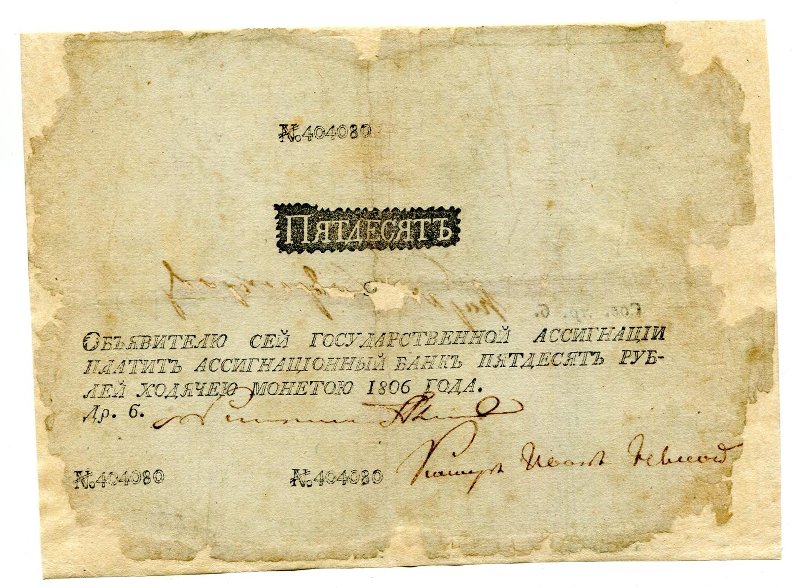
Russian Empire 50 Ruble Assignat, 1806 (1806 Issue)
This assignat features a functional and text-centric design typical of early Russian paper money. It is printed in black ink on light-colored paper. The denomination 'ПЯТЬДЕСЯТЬ' (Fifty) is centrally located within an ornate, decorative rectangular frame. The main body of the note consists of a legal tender declaration in pre-reform Russian orthography. Serial numbers are prominently displayed in three locations (top, bottom left, bottom center). The overall aesthetic is utilitarian, prioritizing clarity and official authentication over elaborate artistic embellishment.
Description
This is a 50 Ruble Assignat from the Russian Empire, issued in 1806. Assignats were the first form of paper money in Russia, introduced in 1769. The 1806 issue represents a crucial period in Russian monetary history, as it was part of a series of financial reforms aimed at stabilizing the economy after the Napoleonic Wars and replacing earlier, less stable issues. The note prominently states: 'ОБЪЯВИТЕЛЮ СЕЙ ГОСУДАРСТВЕННОЙ АССИГНАЦИИ ПЛАТИТЬ АССИГНАЦИОННЫЙ БАНКЪ ПЯТЬДЕСЯТЪ РУБЛЕЙ ХОДЯЧЕЮ МОНЕТОЮ 1806 ГОДА.' (To the bearer of this State Assignat, the Assignat Bank shall pay fifty rubles in current coin of the year 1806). This declaration underscores its redeemable nature in metallic currency. The denomination 'ПЯТЬДЕСЯТЬ' is presented within an ornate border, and the serial number '№ 404080' is repeated three times for security. The note features multiple handwritten signatures, including the clearly legible 'Кассиръ Иванъ Федоровъ' (Cashier Ivan Fyodorov) and a faded Director's signature ('Др. 6.' is likely an abbreviation for 'Директор'). This assignat is a significant historical artifact, providing insight into the monetary system of the Russian Empire during a period of significant geopolitical and economic change.