
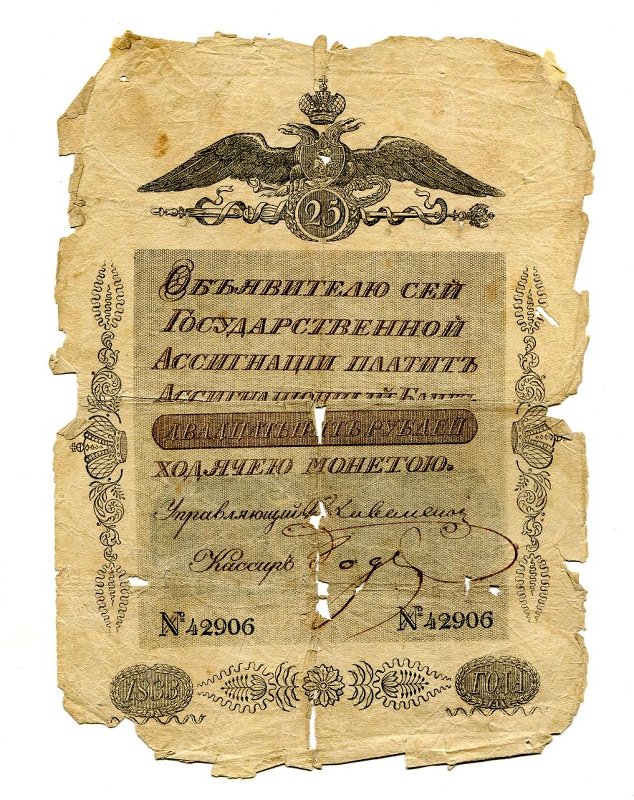
Russian Empire 25 Ruble Assignat, 1786 (1786-1819 Period)
The assignat features a classical Russian Empire design for its early paper money. The top prominently displays the crowned double-headed eagle of the Russian Empire, holding a scepter and orb, with the denomination '25' enclosed in a cartouche on its breast. The central field is a rectangular block with an intricate background pattern, containing the main explanatory text in Cyrillic script. Ornate vertical borders resembling columns or decorative patterns frame the central text block. The bottom part includes serial numbers, two circular seals ('УБЕ' and 'ГОЛ.'), and a central floral/gear-like ornament.
Description
This is a 25 Ruble Assignat from the Russian Empire, issued as part of the 1786-1819 series of state paper money. The note features the iconic double-headed eagle emblem of the Russian Empire at the top, bearing the numerical denomination '25' on its breast, symbolizing the state's guarantee. The central inscription reads 'Объявителю сей Государственной Ассигнации платить ДВАДЦАТЬ ПЯТЬ РУБЛЕЙ ХОДЯЧЕЮ МОНЕТОЮ,' translating to 'To the bearer of this State Assignat pay TWENTY FIVE RUBLES in circulating coin.' This phrase guaranteed the note's exchangeability for metallic currency, though actual convertibility often varied historically. The assignats were crucial for financing the vast expenditures of the Russian Empire, particularly during periods of warfare. Below the main text, the serial number 'N° 42906' is visible twice, a security feature of the time. Hand-written signatures of the Manager ('Управляющий') and Cashier ('Кассиръ') are also present, lending authenticity. The seals 'УБЕ' (likely for Удельный Банк — Appanage Bank) and 'ГОЛ.' (likely for Головной — Head/Main, possibly referring to a specific department or type of issue) are located at the bottom. This particular note represents a significant piece of Russian financial history, reflecting the economic policies and design aesthetics of the late 18th and early 19th centuries.