
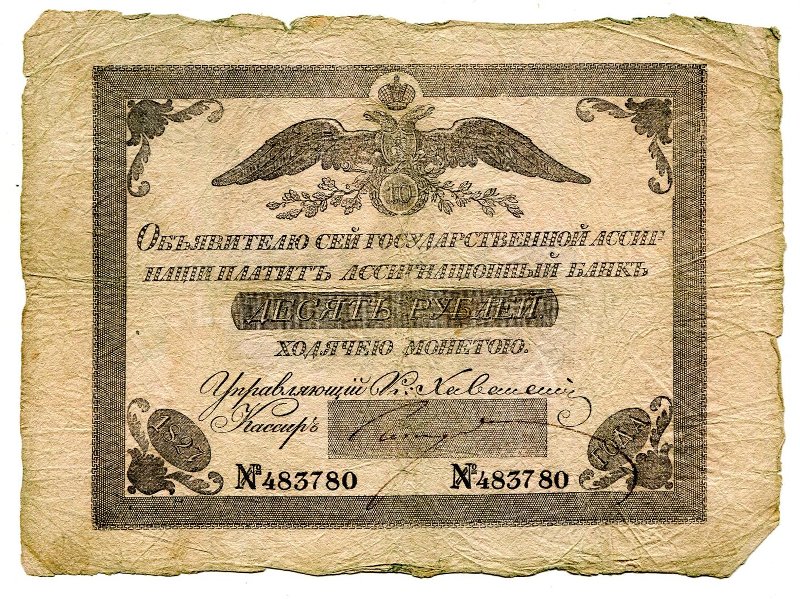
Russian Empire 10 Ruble Assignat, 1822 (1819-1843 Period)
The assignat features a prominent crowned double-headed eagle at the top, a symbol of the Russian Empire, clutching a laurel branch and an oak branch. A shield bearing the denomination "10" is centrally placed on its chest. The main body of the note carries the inscription "ОБЪЯВИТЕЛЮ СЕЙ ГОСУДАРСТВЕННОЙ АССИГНАЦИИ ИМЕЕТЪ ПЛАТИТЬ АССИГНАЦИОННЫЙ БАНКЪ ДЕСЯТЬ РУБЛЕЙ ХОДЯЧЕЮ МОНЕТОЮ." (To the bearer of this State Assignat, the Assignat Bank shall pay TEN RUBLES in current coin). The note is framed by an intricate geometric border with decorative corner elements. The year "1822" is displayed within decorative oval frames in the bottom corners. Signatures of the Manager and Cashier are present below the main text.
Description
This is an important historical artifact, a 10 Ruble Assignat from the Russian Empire, issued in 1822. These assignats represent the paper money system in Russia during a critical period of financial reform following the Napoleonic Wars. The design features the majestic crowned double-headed eagle, emblem of the Imperial Russian state, with a "10" on its breast shield. The central inscription details the promise of the Assignat Bank to pay the bearer ten rubles in "current coin," underscoring the note's function as a form of state-backed paper currency. The specific year "1822" is clearly presented in elegant oval frames in the lower corners, which is characteristic of the 1819-1843 series. Collectors will note the signatures of "Управляющий" (Manager) И. Хвостовой and "Кассиръ" (Cashier) М. Кожевниковъ, which are typical for this denomination and year. While the banknote shows considerable wear—numerous folds, tears along the edges, and general discoloration—it remains a highly collectible piece illustrating Russia's early paper money history. Its condition, though not pristine, reflects its active circulation and historical journey, making it an authentic piece of its era.