
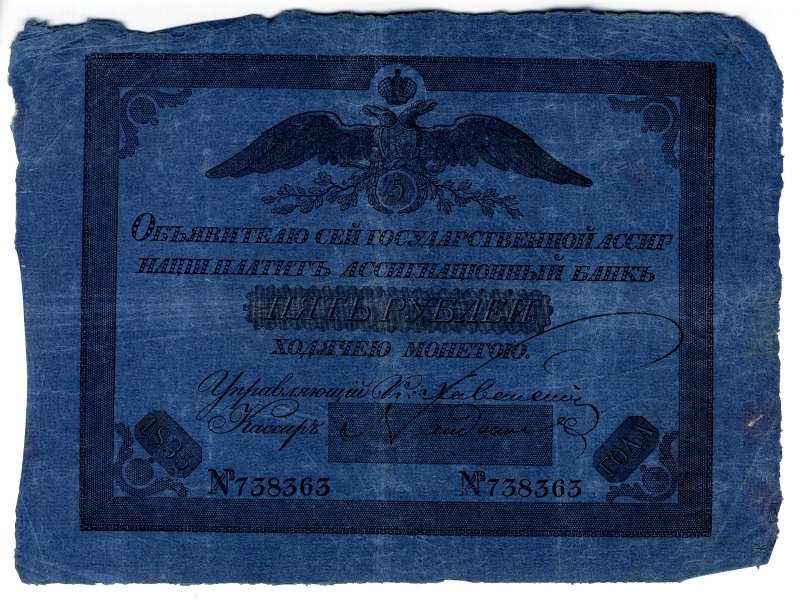
Russian Empire 5 Ruble Assignat, 1835 (1819-1843 Period)
This 5 Ruble assignat features a rather austere and functional design, characteristic of Russian assignats from this period. It is printed in dark blue ink on blue paper, giving it a monochromatic appearance. The central motif is the Imperial double-headed eagle, crowned and holding a scepter and orb, with a shield bearing the St. George patron saint on its chest (though less detailed on this small denomination). The denomination 'ПЯТЬ РУБЛЕЙ' is prominently displayed in the center. The surrounding text provides the issuer and obligation. The note is framed by a decorative rectangular border with corner embellishments. Hand-signed signatures are present for the manager and cashier. The year '1835' is integrated into an oval cartouche on the bottom left, with 'ГОДА' (Year) in a similar cartouche on the right.
Description
This is a 5 Ruble assignat issued by the Russian Empire in 1835. Assignats were the first paper money introduced in Russia, initially in 1769 under Catherine the Great. This particular issue belongs to the series circulating during the reign of Emperor Nicholas I, specifically from the 1819-1843 period, which saw efforts to stabilize the financial system following the Napoleonic Wars. The inscription 'Объявителю сея Государственной Ассигнации надлежит платить Ассигнационный Банкъ ПЯТЬ РУБЛЕЙ ходячею монетою' translates to 'To the bearer of this State Assignat, the Assignat Bank shall pay FIVE RUBLES in circulating coin,' indicating its function as a promissory note backed by government assets, though its silver convertibility was often suspended or at a fluctuating rate. The note bears the serial number N° 738363 and includes the genuine signatures of the Manager R. Khveshchevich and Cashier A. Andreev. This note represents a significant piece of Russian monetary history, illustrating the challenges of managing paper currency in a vast empire during a period of economic transition and reform leading up to the Kankrin's reform of 1839-1843, which eventually replaced assignats with more stable State Credit Notes.