
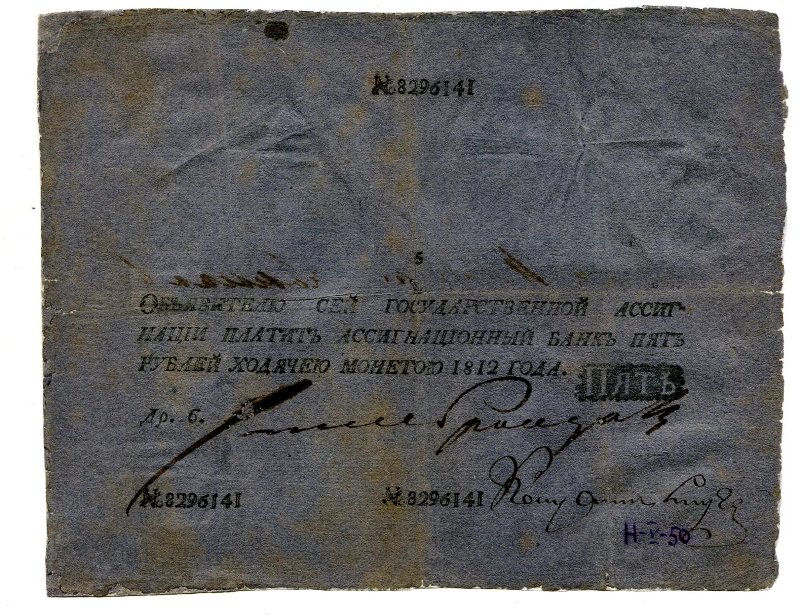
Russian Empire 5 Ruble Assignat, 1812 (1786-1819 Period)
The assignat features a minimalist, text-based design typical of Russian paper currency of the early 19th century. Printed on a blueish-grey paper, the note's design is focused on clarity of information rather than elaborate artistic elements. The denomination 'ПЯТЬ РУБЛЕЙ' (FIVE RUBLES) is prominently displayed and reinforced by a large numeral '5'. A key security feature is the deeply stamped, often embossed, text 'ПЯТЬ' (FIVE) in the lower right, which helped deter counterfeiting. The reverse side (as shown) contains the promise to pay by the Assignat Bank and the required signatures of bank officials. The overall aesthetic is functional and austere, reflecting the era's approach to state-issued paper money.
Description
This is a 5 Ruble Assignat issued by the Russian Empire in 1812, falling within the 1786-1819 period of assignat circulation. These assignats were a crucial form of paper money, first introduced by Catherine the Great, designed to alleviate the shortage of metal coinage and finance state expenditures, particularly during the Napoleonic Wars. The note states: 'Объявителю сей государственной ассигнации платить ассигнацiонный банкъ пять рублей ходячею монетою 1812 года' (To the bearer of this state assignat, the Assignat Bank shall pay five rubles in current coin of the year 1812). The distinct blueish-grey paper, along with watermarks (though not visible in this image) and the impressed 'ПЯТЬ' stamp, served as primary security features against counterfeiting. This specific note carries the serial number N° 8296141. The reverse side (shown here) features the required signatures of the bank's director and cashier, validating its authenticity. As a historical artifact, it offers insight into the financial system and economic challenges of the Russian Empire during a tumultuous period.