
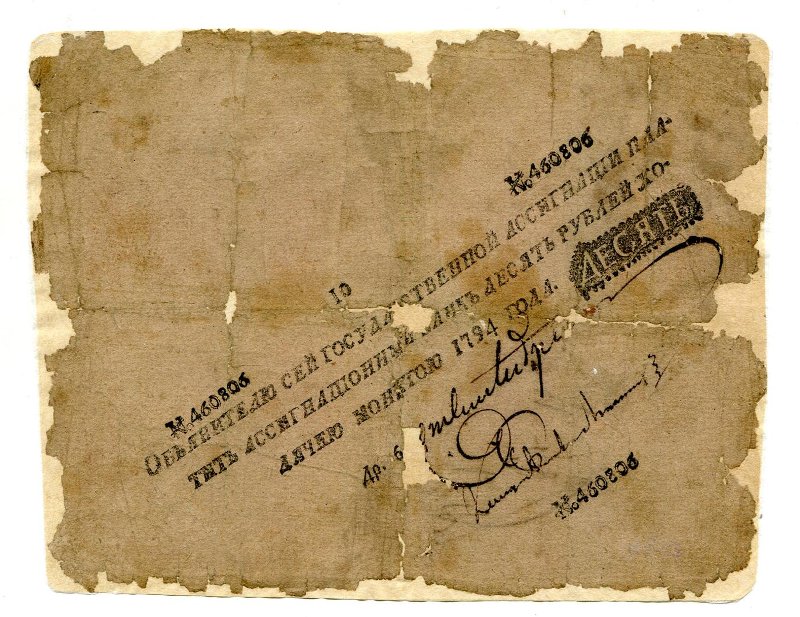
Russian Empire 10 Ruble Assignat, 1794 (Catherine the Great Period)
This assignat features a simple, functional design typical of early paper money. Printed on brownish paper with black ink, it emphasizes textual declarations of value rather than elaborate artistic elements. The main declaration is printed diagonally across the note, stating its value and legal tender status. A distinct feature is the black stamped denomination 'ДЕСЯТЬ' (TEN) with an ornamental border, superimposed over the printed text. The design includes a numerical denomination '10' and serial numbers printed multiple times, along with handwritten official signatures.
Description
This is a 10 Ruble Assignat issued by the Russian Empire in 1794. Assignats were the first paper currency issued in Russia, introduced during the reign of Catherine the Great to address the shortage of coinage and finance state expenditures. This particular note belongs to the second major issue period (1786-1819), characterized by a standardized design for different denominations. The text prominently declares: 'TO THE BEARER OF THIS STATE ASSIGNAT PAY TEN RUBLES IN CURRENT COIN OF THE YEAR 1794.' (ОБЪЯВИТЕЛЮ СЕЙ ГОСУДАРСТВЕННОЙ АССИГНАЦИИ ПЛАТИТЬ ДЕСЯТЬ РУБЛЕЙ ХОДЯЧЕЮ МОНЕТОЮ 1794 ГОДА.). The note bears the serial number N° 460806, which is repeated in several places. Two handwritten signatures, likely those of a director and a cashier from the Assignation Bank, are visible, providing an authentication element typical for the era. The stamped 'ДЕСЯТЬ' (TEN) reinforces the denomination and serves as an anti-counterfeiting measure. 'Ар. 6' (Article 6) is also visible, which might refer to an internal regulation or series number. These assignats represent a crucial period in Russian financial history, reflecting attempts to stabilize the economy through paper money, despite often fluctuating values.