
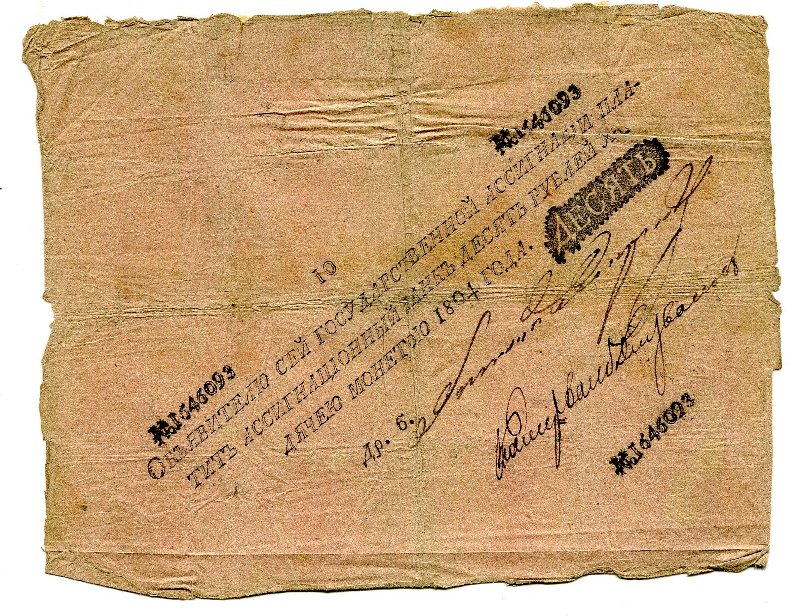
Russian Empire 10 Ruble Assignat, 1804 (1786-1819 Period)
This assignat features a minimalistic and functional design, typical of early Russian paper money. The text is printed in black ink on a brownish, coarse paper. The core elements include the denomination, the year of issue, a promise to pay the bearer, and multiple instances of the serial number (N.144093, printed four times). A prominent black 'ДЕСЯТЬ' (TEN) overstamp adds a distinctive visual characteristic. The design emphasizes textual information over elaborate graphical elements, with handwritten signatures serving as key security features for validation.
Description
This is a 10 Ruble Assignat issued by the Russian Empire in 1804. Assignats were the primary form of paper money in Russia from 1769 until the mid-19th century, serving as state-issued banknotes. This specific note belongs to the second issue period (1786-1819), characterized by its relatively simplified design and the crucial presence of handwritten signatures of government officials for authentication. The note prominently states: 'Объявителю сей Государственной Ассигнацiи платить Десять рублей ходячею монетою 1804 года.' (To the bearer of this State Assignat pay Ten Rubles in circulating coin of 1804). A distinct black 'ДЕСЯТЬ' overstamp is visible, likely applied to clearly emphasize the denomination or as part of a revalidation process for notes in circulation. These assignats played a vital role in the Russian economy, especially during significant historical events like the Napoleonic Wars, though their value often fluctuated against specie. Collectors highly value these assignats for their profound historical significance, representing a key era in Russian monetary and economic history. The serial number N.144093 is clearly visible in multiple locations on the note. The assignat features two handwritten signatures, characteristic of the security measures employed during that period.