
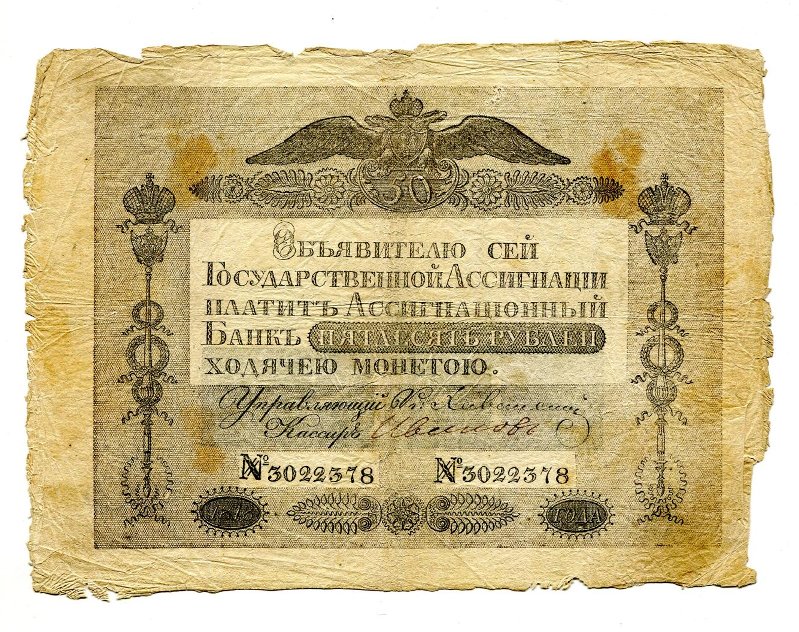
Russian Empire 50 Ruble Assignat, 1786 (1786-1819 Period)
Classical design with a central text block framed by ornate patterns. Features the Imperial double-headed eagle with crowns, scepter, and orb, incorporating the denomination '50' on its chest. Side borders consist of vertical columns adorned with crowns and intertwined serpents. The paper is coarse, indicative of early banknote production methods. Printed in monochrome, primarily black ink on a light background.
Description
This is a significant 50 Ruble assignat from the Russian Empire, a form of paper money introduced to facilitate trade and state finances during the late 18th and early 19th centuries. It represents the '1786 type,' a design that remained in circulation and production from 1786 until 1819. The obverse prominently displays the Imperial double-headed eagle with crowns, a scepter, and an orb, symbolizing the sovereignty of the Russian state, with the numerical denomination '50' embedded within the eagle's design. The central text, 'ОБЪЯВИТЕЛЮ СЕЙ ГОСУДАРСТВЕННОЙ АССИГНАЦІИ ПЛАТИТЬ АССИГНАЦІОННЫЙ БАНКЪ ПЯТЬДЕСЯТЬ РУБЛЕЙ ХОДЯЧЕЮ МОНЕТОЮ,' translates to a promise of payment of fifty rubles in circulating coin by the Assignat Bank. The ornate vertical borders feature classical motifs of crowns and intertwined serpents, adding to its regal aesthetic. The serial number, N° 3022578, is clearly visible at the bottom. Although the designated 'ГОДА' (Year) oval is blank, this is typical for many printings of this series, confirming its origin within the broader 1786-1819 period. The note bears the faded handwritten signatures of the Manager ('Управляющіи') and Cashier ('Кассиръ'), essential for its authentication during its time. Despite its age and condition, marked by creasing, tears, and discoloration, this assignat serves as a tangible artifact of Russia's early paper money system and its economic history.