
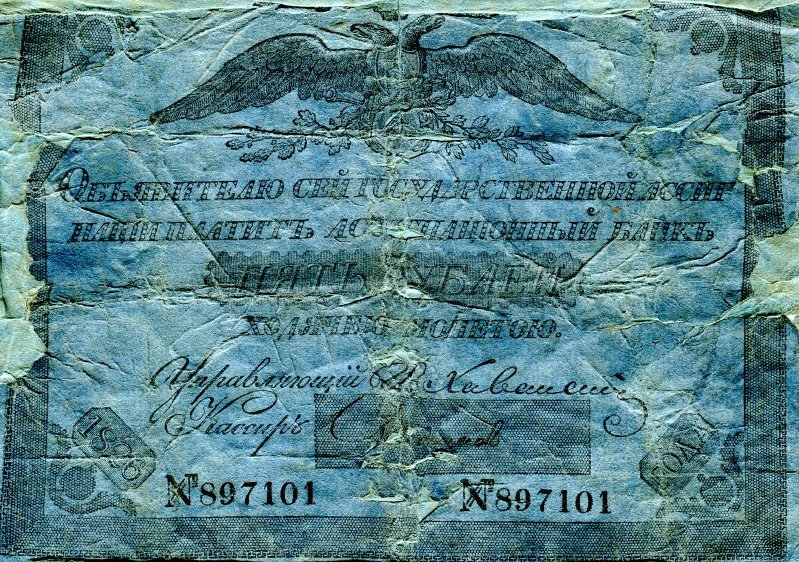
Russian Empire 5 Ruble Assignat, 1802 (1786-1819 Period)
The assignat features a classical design common for Russian paper currency of the late 18th and early 19th centuries. The central motif is the crowned double-headed eagle of the Russian Empire, holding a scepter and orb, with a wreath below. The text is in traditional pre-reform Russian Cyrillic script, prominently stating the denomination and the issuing authority (Assignation Bank). The borders feature a simple geometric pattern (Greek key) at the bottom. The color palette is predominantly blue-green, characteristic of 5 ruble notes of this era.
Description
This is a 5 Ruble Assignat issued by the Russian Empire in 1802. The assignats were a form of paper money introduced in Russia to supplement the metallic currency and finance government expenditures. This particular note belongs to the large series issued between 1786 and 1819. It prominently displays the imperial double-headed eagle at the top, signifying its state backing. The main inscription reads: 'Объявителю сея Государственной ассигнации платитъ Ассигнаціонный Банкъ ПЯТЬ РУБЛЕЙ ходящею монетою.' (The Bearer of this State Assignat is to be paid by the Assignation Bank FIVE RUBLES in circulating coin). The serial number N° 897101 is printed twice at the bottom. The year '1802 ГОДА' (1802 Year) is partially visible in the bottom corners, stamped into the design. Signatures of the 'Управляющий' (Manager/Director) and 'Кассиръ' (Cashier) are present below the main text, which are consistent with the 1802-1803 issues. These notes played a crucial role in the Russian economy during a period of significant military campaigns and administrative reforms. Their value often fluctuated against metallic currency, reflecting the economic conditions of the time.