
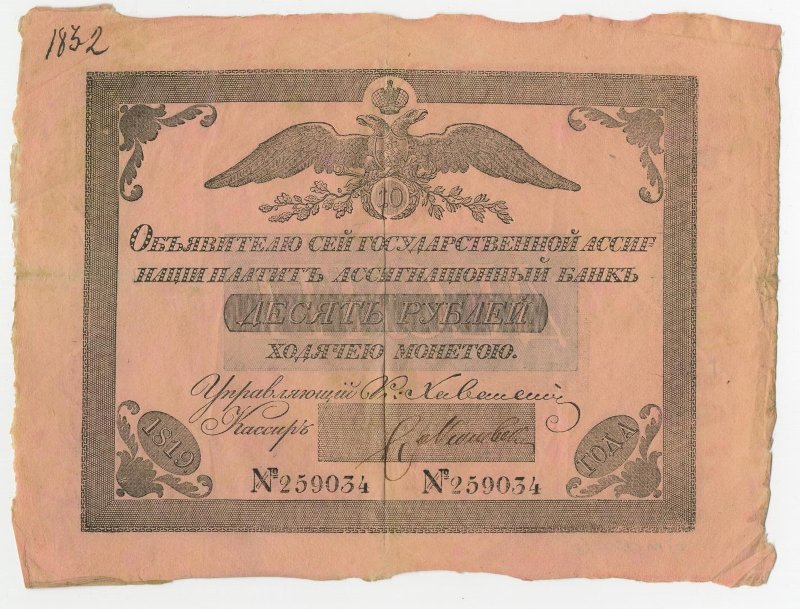
Russian Empire 10 Ruble Assignat, 1819 (1819-1843 Period)
The assignat features a typical design for Russian paper money of the early 19th century, characterized by a pink-reddish paper color and dark brown-black ink. The central motif is the Imperial double-headed eagle, crowned, holding a shield with the numeral '10' on its chest, surrounded by a wreath. The text is rendered in traditional Cyrillic script (pre-1918 orthography). The border features an intricate geometric pattern, with ornate floral elements in the corners. The year '1819' and the word 'ГОДА' (Year) are enclosed in decorative ovals in the lower left and right corners, respectively. The overall aesthetic is classical and official, reflecting the state's authority.
Description
This is a 10 Ruble Assignat from the Russian Empire, issued in 1819, belonging to the series produced between 1819 and 1843. These assignats were a form of fiat paper money, introduced by Catherine the Great in 1769 and circulating until the mid-19th century, designed to ease the burden of heavy metal currency. The 1819 series was part of a major currency reform initiated by Emperor Alexander I following the Napoleonic Wars, aiming to stabilize the financial system and re-establish confidence in paper money. Despite these efforts, assignats faced depreciation over time. The banknote prominently features the Imperial double-headed eagle and the explicit promise 'To the bearer of this State Assignat, the Assignat Bank shall pay TEN RUBLES in circulating coin.' The serial number 'N° 259034' is printed twice at the bottom. This particular note shows clear signs of circulation and age, making it a valuable historical artifact for collectors interested in Russian monetary history and the evolution of paper currency.