
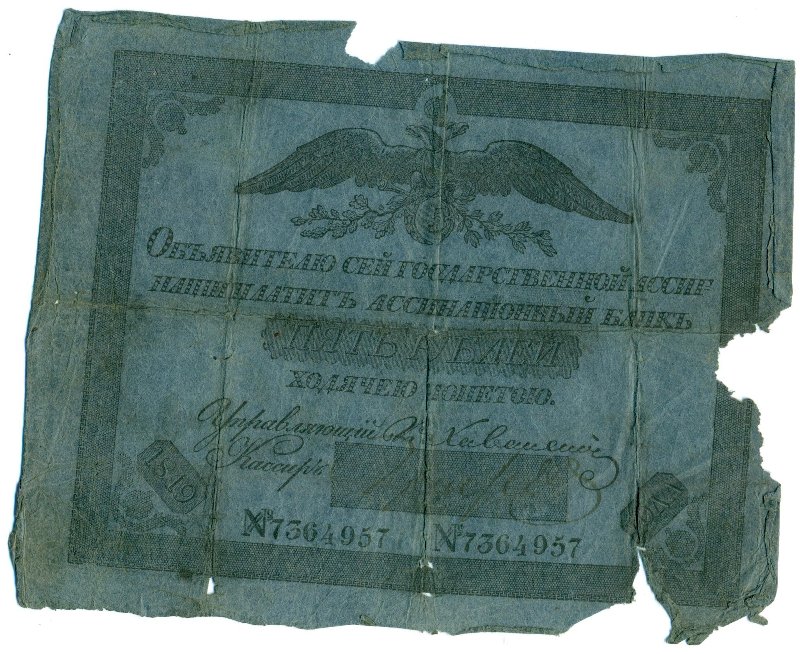
Russian Empire 5 Ruble Assignat, 1819 (1786-1819 Period)
The assignat features a classical, somewhat minimalistic design typical for early Russian paper currency. The central motif is the double-headed Imperial Russian eagle with a crown and a laurel wreath, symbolizing state authority. The text is in Cyrillic, using an older orthography, predominantly in a clear, sans-serif-like font for the main proclamation and a decorative, flowing script for the denomination 'ПЯТЬ РУБЛЕЙ'. The entire design is enclosed within a patterned rectangular border, exhibiting guilloche-like patterns, printed in a monochrome blue-green ink on what was originally blue paper.
Description
This is a 5 Ruble assignat issued by the Russian Empire in 1819, falling within the 1786-1819 period of assignat issuance. The banknote features the prominent double-headed Imperial Russian eagle at the top, a symbol of the Russian state. Below it is the primary text 'ОБЪЯВИТЕЛЮ СЕЙ ГОСУДАРСТВЕННОЙ КАССЫ НАПЕЧАТАТЬ АССИГНАЦIОННЫЙ БАНКЪ' (To the bearer of this state treasury, the Assignation Bank will print), followed by the denomination 'ПЯТЬ РУБЛЕЙ' (Five Rubles) and the phrase 'ХОДЯЧЕЮ МОНЕТОЮ.' (In circulating coin). This indicates its legal tender status. The note bears two serial numbers, 'N° 7364957', printed at the bottom. On the left side, an oval stamp with the year '1819' is visible. Below the denomination, there are spaces for signatures of the 'Управляющий' (Manager) and 'Кассиръ' (Cashier), with handwritten signatures present. Assignats were the first paper currency issued in Russia, introduced by Catherine the Great, and this particular issue belongs to a later period when various denominations and security features were developed. Despite its worn condition, it remains a significant historical artifact representing early Russian monetary policy and banking.