
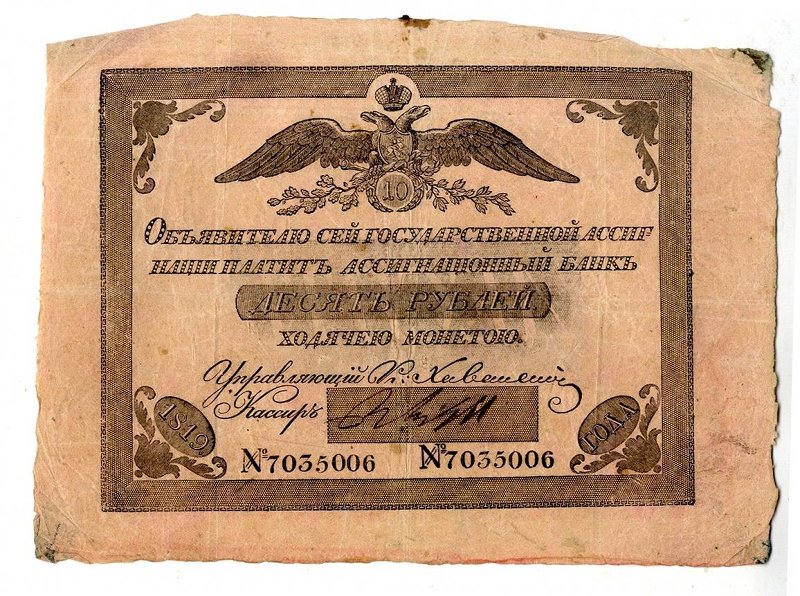
Russian Empire 10 Ruble Assignat, 1819 (1786-1819 Period)
The banknote features a classic design for Russian assignats of the early 19th century. The central motif is the Imperial double-headed eagle, crowned, holding a wreath containing the denomination '10'. The main text block details the promise of payment. The border is composed of intricate geometric patterns and stylized floral/scrollwork elements in the corners. The overall aesthetic is formal and indicative of government-issued currency of the era, printed in a single color (brownish-red) on light paper.
Description
This is a 10 Ruble Assignat issued by the Russian Empire in 1819, falling within the 1786-1819 period of assignat circulation. Assignats were the first paper money in Russia, introduced in 1769, and played a crucial role in the Imperial economy, particularly during wartime. The banknote features the prominent double-headed eagle emblem of the Russian Empire at its top center, signifying its state backing. The central inscription reads: "ОБЪЯВИТЕЛЮ СЕЙ ГОСУДАРСТВЕННОЙ АССИГНАЦИИ НАШЪ ПЛАТИТЪ АССИГНАЦІОННЫЙ БАНКЪ ДЕСЯТЬ РУБЛЕЙ ХОДЯЧЕЮ МОНЕТОЮ." (To the bearer of this State Assignat, our Assignation Bank will pay Ten Rubles in circulating coin.) The year '1819' is clearly visible in an oval cartouche in the lower left, while the word 'ГОДА' (year) is in a similar cartouche on the right. Below the main text, the serial number 'N° 7035006' is printed twice. This specific issue (1819) represents a late stage of the second assignat series before the monetary reform of 1843, and examples from this period are significant historical artifacts reflecting Russia's financial history.