
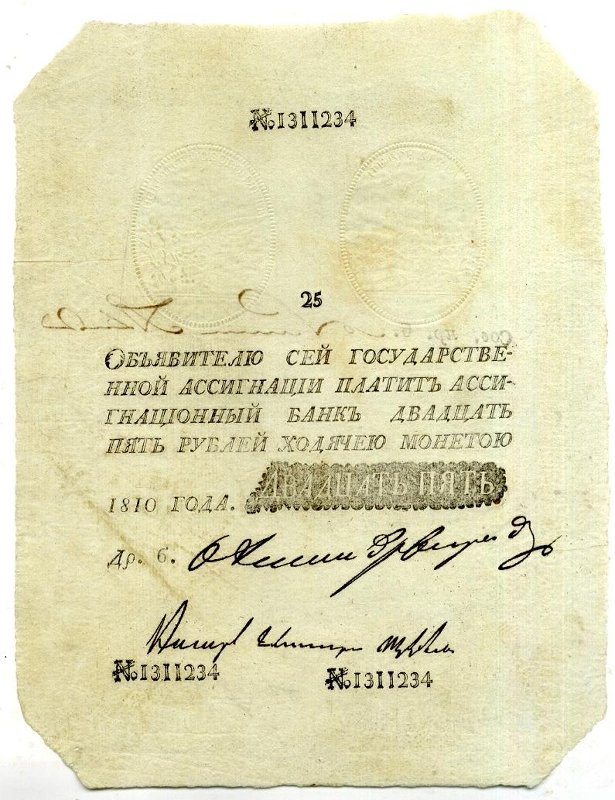
Russian Empire 25 Ruble Assignat, 1810 (1786-1819 Period)
The assignat features a simple, text-based design printed in black ink on light, slightly textured paper. The main body of the note consists of a declaration that the Assignation Bank will pay the bearer twenty-five rubles in circulating coin. The numerical denomination '25' is prominently placed at the top center. A distinctive security feature is the oval/rectangular overprint 'ДВАДЦАТЬ ПЯТЬ' (Twenty Five) below the main text, printed in a slightly different, textured font. Two faint oval watermarks are visible in the upper central area, suggesting early security measures. Serial numbers are printed in three locations: top center, bottom left, and bottom right, adding to the anti-counterfeiting measures of the era. The note is signed by two officials.
Description
This is a significant historical banknote, a 25 Ruble Assignat issued by the Russian Empire in 1810, belonging to the 1786-1819 period of assignat emissions. Assignats were the primary paper currency of the Russian Empire from the reign of Catherine the Great until the mid-19th century. This particular note carries the serial number № 1311234, visible in triplicate, a common security practice for the era. The design is characteristic of early Russian paper money, emphasizing security through multiple textual declarations, specific typography for the denomination overprint 'ДВАДЦАТЬ ПЯТЬ', watermarks (though faint), and handwritten signatures of key bank officials. The assignat was issued by the Assignation Bank, established to finance state expenditures, particularly during times of war, and to alleviate the shortage of metal coinage. These notes represent a crucial phase in the development of the Russian financial system and are highly collectible for their historical value and intricate early security features. Despite visible wear and aging, the note remains largely intact and legible, offering a tangible connection to early 19th-century Russian economic history.