
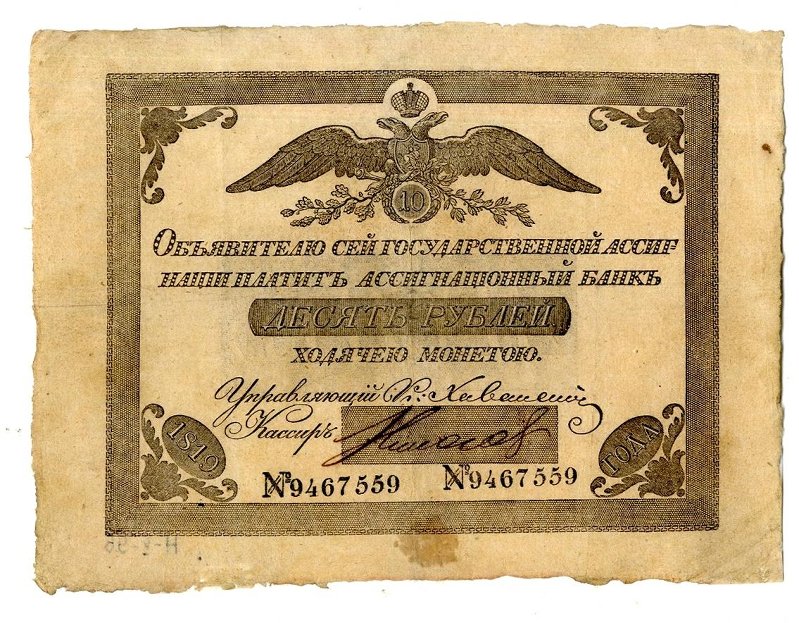
Russian Empire 10 Ruble Assignat, 1819 (1819-1843 Period)
The assignat features a classical, somewhat minimalist design typical for Russian paper money of the early 19th century. The central motif is the Imperial double-headed eagle, crowned and holding a wreath with the denomination '10'. Below the eagle, the main text states the promise of payment. The design includes a rectangular ornamental border with scrollwork elements in the corners. The denomination 'ДЕСЯТЬ РУБЛЕЙ' is prominently displayed in a decorative cartouche. The year '1819' and the word 'ГОДА' (year) are set in ornate oval cartouches in the lower corners. The signatures of the managing director and cashier are placed below the main text. The overall aesthetic emphasizes officiality and security through intricate engraving rather than complex multi-color printing, characteristic of the period's technological capabilities.
Description
This is a 10 Ruble Assignat from the Russian Empire, issued in 1819. It belongs to the series introduced as part of the monetary reform of 1819, which aimed to stabilize the depreciated assignats. These notes were issued by the State Assignation Bank and were a primary form of paper currency in the Russian Empire until the mid-19th century. The obverse prominently displays the Imperial double-headed eagle, a symbol of Russian statehood, with the denomination '10' within a wreath. The main text reads: 'ОБЪЯВИТЕЛЮ СЕЙ ГОСУДАРСТВЕННОЙ АССИГНАЦІИ ПЛАТИТЬ АССИГНАЦІОННЫЙ БАНКЪ ДЕСЯТЬ РУБЛЕЙ ХОДЯЧЕЮ МОНЕТОЮ.' (To the bearer of this State Assignat, the Assignation Bank shall pay TEN RUBLES in circulating coin). The year '1819' is clearly visible in the lower-left cartouche, indicating its specific issue date. The serial number '№9467559' is printed twice below the signatures. These assignats are significant historical artifacts, reflecting the economic policies and monetary system of Imperial Russia during a period of transition and reform.