
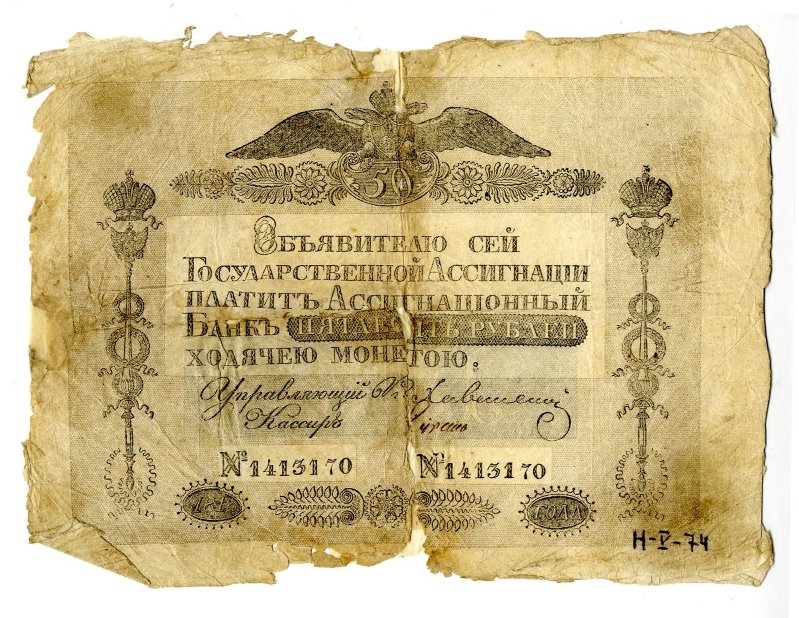
Russian Empire 50 Ruble Assignat, 1786 (1786-1819 Period)
The banknote features a classic Russian Imperial design. At the top, a crowned double-headed eagle with a shield bearing the Moscow coat of arms (St. George slaying the dragon) on its chest. The denomination "50" is prominently displayed within this shield. The central inscription reads: "ОБЪЯВИТЕЛЮ СЕЙ ГОСУДАРСТВЕННОЙ АССИГНАЦИИ ПЛАТИТЬ АССИГНАЦИОННЫЙ БАНКЪ ПЯТЬДЕСЯТЬ РУБЛЕЙ ХОДЯЧЕЮ МОНЕТОЮ" (The bearer of this State Assignat is to be paid by the Assignat Bank Fifty Rubles in current coin). The main text is framed by two ornate vertical pillars, each topped with a crown, and decorated with garlands and geometric patterns. Below the main text, spaces are reserved for the signatures of the manager and cashier. The serial number is printed twice at the bottom.
Description
This is a significant historical artifact: a 50 ruble assignat from the Russian Empire, issued as part of the 1786 series, which represents a crucial period in Russian monetary history under Catherine the Great. Assignats were the first paper currency introduced in Russia, designed to alleviate the shortage of metal coinage and finance state expenditures. The 1786 series, characterized by its ornate design featuring the Imperial double-headed eagle and the fixed denomination within the shield, was a cornerstone of the Russian financial system for decades. This particular note, with serial number N° 1413170 and signatures of Manager S. Lebedev and Cashier Avram, offers a tangible link to the late 18th and early 19th-century economy. Despite its very poor condition with extensive wear, tears, and discoloration, its rarity and historical importance make it a valuable collectible for those interested in early Russian paper money, numismatics, and the economic policies of the Russian Empire. It serves as a testament to the challenges and developments in monetary circulation during a transformative era.