
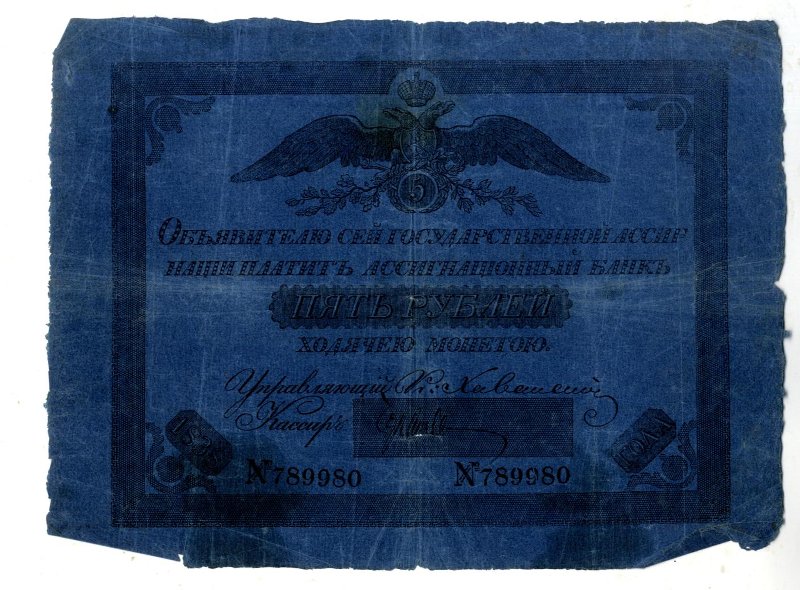
Russian Empire 5 Ruble Assignat, 1800 (1786 Series, Kaverin-Apte Signatures)
The assignat features a classic design for Russian Empire banknotes of its era. The central motif is a large double-headed imperial eagle crowned, holding a scepter and orb, with a shield on its chest bearing the numeral '5' within a wreath. The denomination text 'ПЯТЬ РУБЛЕЙ' (FIVE RUBLES) is prominently displayed below the eagle. The note is printed on distinct blue paper, characteristic of the 5 Ruble denomination from the 1786 series. It includes ornate decorative borders and intricate typography for the text stating the promise to pay. The overall style is formal and indicative of government-issued currency designed for security and authority.
Description
This is a 5 Ruble Assignat from the Russian Empire, part of the 1786 series of paper money. These assignats were introduced by Empress Catherine the Great to address the financial needs of the vast empire and facilitate trade. The blue color was specific to the 5 ruble denomination to help prevent counterfeiting and make identification easier. This particular note features the signatures of V.S. Kaverin (Управляющіи – Manager), who served from 1797 to 1809, and S. Apte (Кассиръ – Cashier). While the series began in 1786, the signatures indicate an issue date within Kaverin's tenure. For cataloging purposes, and given the lack of a clearly printed year on the banknote itself (the 'ГОДЪ' field is illegible), a representative year like 1800 is often attributed, placing it during the reign of Emperor Paul I or early Alexander I. The text 'ОБЪЯВИТЕЛЮ СЕЙ ГОСУДАРСТВЕННОЙ АССИГНАЦИИ НАШИ ПЛАТИТЬ АССИГНАЦИОННЫЙ БАНКЪ ПЯТЬ РУБЛЕЙ ХОДЯЧЕЮ МОНЕТОЮ' translates to 'To the bearer of this State Assignat, the Assignat Bank shall pay Five Rubles in circulating coin.' This assignat is a significant historical artifact, representing a pivotal period in Russian monetary history before the full adoption of metal-backed currency. It is a valuable collectible for those interested in Imperial Russian numismatics and the evolution of paper money.