
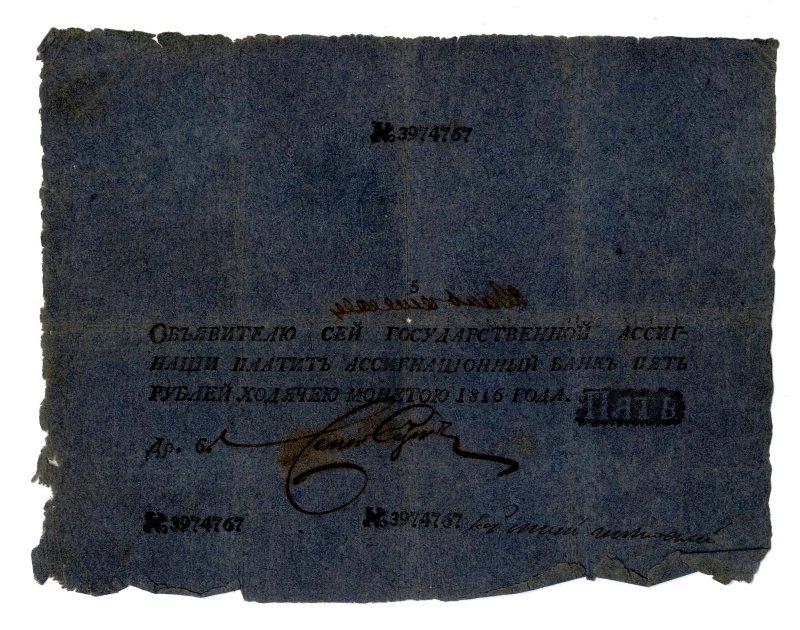
Russian Empire 5 Ruble Assignat, 1816
The assignat features a minimalist and functional design, characteristic of early Russian paper money. Printed on blue paper with dark brown/black ink, the design is primarily textual. The central declaration states the promise of payment. Key elements include the denomination 'ПЯТЬ' (FIVE) stamped prominently in a black rectangular box, serial numbers '№ 3974767' displayed at the top, bottom left, and bottom right corners, and a large handwritten signature in the lower center. The paper is plain, without complex engravings or security features common in later banknotes, relying more on the paper type and hand signatures for authenticity. The overall aesthetic is utilitarian, prioritizing clarity of information over elaborate artistic elements.
Description
This is a 5 Ruble Assignat issued by the Russian Empire in 1816. Assignats were early forms of paper money, first introduced in Russia by Catherine the Great in 1769. The 1816 issue belongs to the second major series of assignats, regulated by a decree of 1816, which aimed to stabilize the financial system after the Napoleonic Wars. The central text reads: 'Объявителю сей Государственной Ассигнации платить Ассигнационный Банкъ ПЯТЬ РУБЛЕЙ ходячею монетою 1816 года.' (To the bearer of this State Assignat, the Assignat Bank shall pay FIVE RUBLES in circulating coin of 1816). This note represents a significant piece of Russian monetary history, reflecting a period of financial reconstruction and the transition from a purely metallic currency to a more complex system including paper money. The serial number '№ 3974767' is prominently displayed. The presence of a handwritten signature (likely of a Director) further authenticates each individual note. These assignats were crucial for government financing and everyday transactions in the Russian Empire for several decades, despite facing issues with inflation and public trust.