
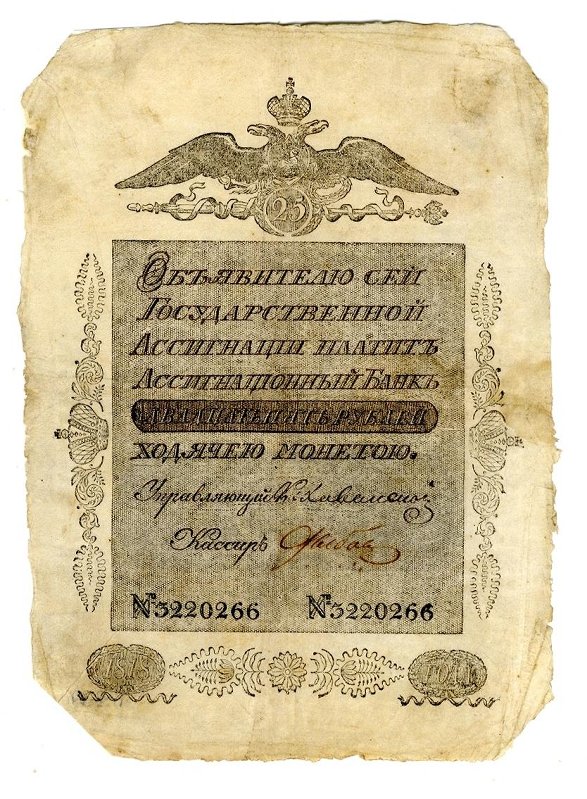
Russian Empire 25 Ruble Assignat, 1810 (1786-1819 Period, Lukianov/Shebas Signatures)
The banknote features a classic Imperial Russian design. The central motif is the crowned double-headed eagle of the Russian Empire, holding a scepter and orb, with a shield on its breast enclosing the denomination '25'. The main body of the note is dominated by a large text block in Cyrillic script, promising payment. The borders are adorned with elegant rococo-style floral scrolls, small crowns, and other decorative elements. The text block has a fine mesh background pattern. The serial numbers are prominently displayed at the bottom. The general aesthetic reflects the late 18th to early 19th-century banknote design.
Description
This is a 25 Ruble Assignat issued by the Russian Empire, likely printed around 1810, belonging to the extensive series issued between 1786 and 1819. These assignats were a form of paper money introduced by Catherine the Great to cover state expenses and served as legal tender. The note is undated on its face, a common characteristic for many assignats of this period, but the combination of the 'Управляющiй' (Manager/Director) signature of Lukianov and the 'Кассиръ' (Cashier) signature of Shebas places its production firmly within the reign of Emperor Alexander I, specifically from 1801 to 1819. The central inscription states: 'Объявителю сей Государственной Ассигнации платить Ассигнаціонный Банкъ ДВАДЦАТЬ ПЯТЬ РУБЛЕЙ ходячею монетою.' (To the bearer of this State Assignat, the Assignation Bank will pay TWENTY-FIVE RUBLES in circulating coin.) This piece represents an important era in Russian monetary history, illustrating the transition from metallic currency to paper money and the challenges associated with managing a paper-based economy during times of war and economic change.