
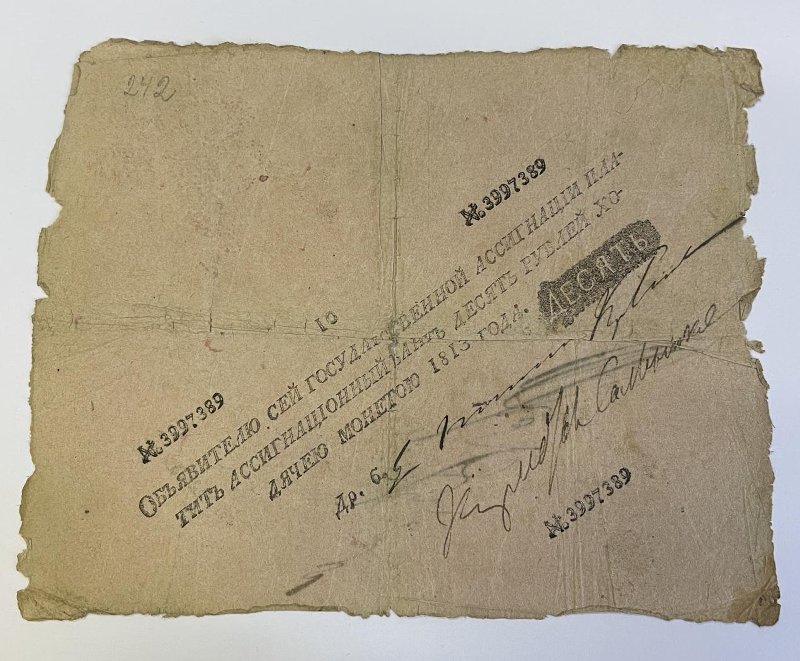
Russian Empire 10 Ruble Assignat, 1813 (Redemption Endorsement)
The image displays the reverse side of a Russian assignat. The design is characterized by an official diagonally stamped endorsement in Cyrillic, signifying redemption. The text is clear and bold. Handwritten annotations and another stamped overprint add to the document's historical character. The paper itself is typical for early paper currency, thick and fibrous, showing significant signs of handling and age. The overall aesthetic is utilitarian, focused on conveying official information rather than decorative elements.
Description
This artifact is the reverse side of a 10 Ruble Assignat from the Russian Empire, distinctively marked with an official redemption endorsement dated 1813. The endorsement reads: "ОБЪЯВИТЕЛЮ СЕЙ ГОСУДАРСТВЕННОЙ АССИГНАЦИИ ПЛА-ТИТЬ АССИГНАЦИОННЫЙ БАНКЪ ДЕСЯТЬ РУБЛЕЙ ХО-ДЯЧЕЮ МОНЕТОЮ 1813 ГОДА." (To the bearer of this State Assignat, the Assignat Bank shall pay Ten Rubles in current coin in the year 1813). This specific type of endorsement indicates that the assignat, originally issued in an earlier series (likely from the 1786-1819 period), was presented for redemption or exchange at the Assignat Bank in 1813. Such notes provide valuable insights into the financial administration and monetary policy of the Russian Empire during the tumultuous period of the Napoleonic Wars and the subsequent efforts to stabilize the national currency. The note features several stamped serial numbers, "№ 3997389", which are clearly visible. A dark, rectangular overprint reading "ДЕСЯТЬ" (Ten) is stamped over the denomination in the endorsement, possibly serving as an additional confirmation or cancellation mark. Various handwritten annotations are present: "242" in the upper left, a small vertical "10" in the center, and "Др. 6,5" (possibly referring to another document or accounting entry). The most prominent handwritten feature is a large signature at the bottom, which appears to be "Кирилловъ Салтыковъ" (Kirillov Saltykov), likely a high-ranking official or cashier of the bank, validating the redemption. Crafted from coarse, durable paper typical of assignats from this era, the note exhibits considerable evidence of its circulation and history. It presents with multiple strong horizontal and vertical folds, creasing, minor tears, particularly along the left edge, and general surface wear. The paper has discolored over time and shows some foxing, all consistent with its age and the material quality. Despite the wear, the integrity of the document remains, and all inscriptions are legible, making it a significant historical piece for collectors interested in early Russian paper currency and financial history.