
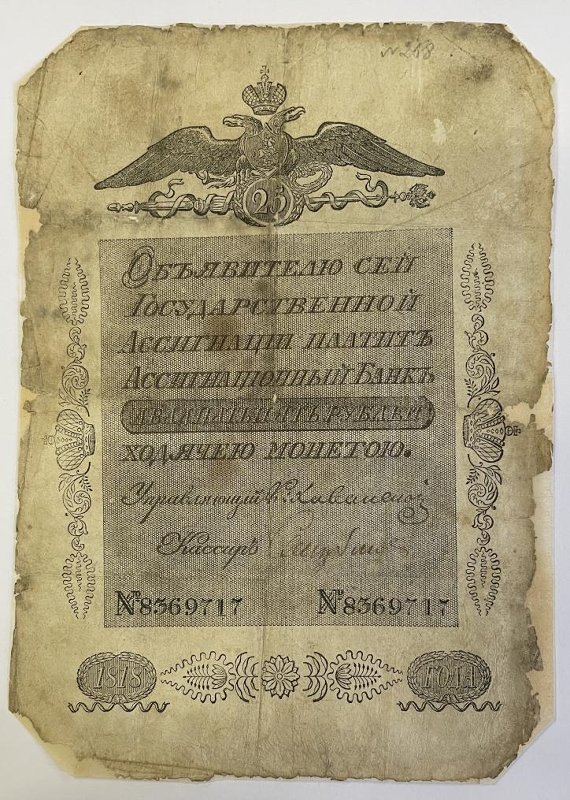
Russian Empire 25 Ruble Assignat, 1818 (1786-1819 Period)
The assignat features a classical, somewhat austere design characteristic of early Russian paper money. The central motif at the top is the Imperial double-headed eagle, crowned and holding a scepter and orb, with the denomination '25' prominently displayed within its body. The main body of the note contains the payment promise text in a clear, legible Cyrillic font, set against a fine mesh background pattern. Ornate, wavy borders with small crown elements run along the left and right sides. The year '1818' and 'ГОДЪ' (Year) are enclosed in decorative oval frames at the bottom left and right, respectively, separated by stylized floral and geometric motifs.
Description
This is a 25 Ruble Assignat issued by the Russian Empire in 1818, belonging to the period of assignats circulated from 1786 to 1819. These assignats were a crucial part of the Russian monetary system, initially introduced by Catherine the Great as a form of paper money to supplement metallic currency and finance state expenditures. The 1818 issues fall within the later part of this period, prior to the major currency reform of 1819, which saw the introduction of new assignats and a change in their redemption terms. The design features the Imperial double-headed eagle at the top and the promise to pay 'ДВАДЦАТЬ ПЯТЬ РУБЛЕЙ ходячею монетою' (twenty-five rubles in circulating coin) by the Assignat Bank. This specific banknote bears serial number N°8369717 and includes the signatures of K. Kavelin (Manager) and P. Aristov (Cashier). Its historical context places it during the reign of Emperor Alexander I, a time of significant economic challenges following the Napoleonic Wars. Despite its worn condition, it represents a tangible piece of Russian financial history and is highly sought after by collectors of imperial Russian paper money.