
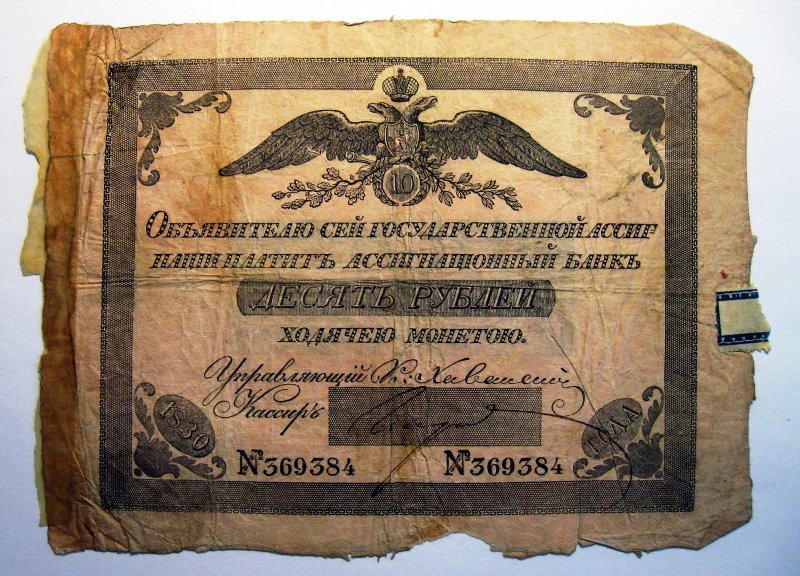
Russian Empire 10 Ruble Assignat, 1830 (1819-1843 Period)
The assignat features a classical design common for the Russian Empire's early 19th-century currency. The central motif is the majestic double-headed imperial eagle, crowned and holding a laurel wreath with the denomination '10' within a shield. The eagle is placed above the main textual declaration. The note is framed by an intricate border composed of geometric patterns (meander-like) and ornate corner embellishments with floral/foliate scrolls. The typography uses traditional Old Cyrillic script, emphasizing formality and state authority. The overall impression is one of sobriety and official gravitas, typical of government-issued paper money of the era.
Description
This is a 10 Ruble Assignat issued by the Russian Empire in 1830, falling within the 1819-1843 period of assignat circulation. These assignats were a primary form of paper money in the Russian Empire for several decades. The front features the iconic double-headed imperial eagle, a symbol of Russian statehood, prominently displayed at the top center. Below the eagle, the text states the obligation of the 'Assignat Bank' to pay 'TEN RUBLES in current coin' to the bearer. The serial number N° 369384 is printed twice at the bottom, flanking the signatures. The year '1830' is elegantly integrated into an oval cartouche in the lower-left corner, mirrored by a decorative element (likely 'ГОДА' / YEAR) in the lower-right. This note bears the signatures of 'Управляющий С. Хвевецкій' (Manager S. Khvevetsky) and an illegible 'Кассиръ' (Cashier), indicating its official issuance. Such notes are significant historical artifacts, reflecting the economic and monetary policies of the Russian Empire under Nicholas I. Despite its worn condition, it remains a valuable piece for collectors interested in Russian numismatics and the history of paper money.