
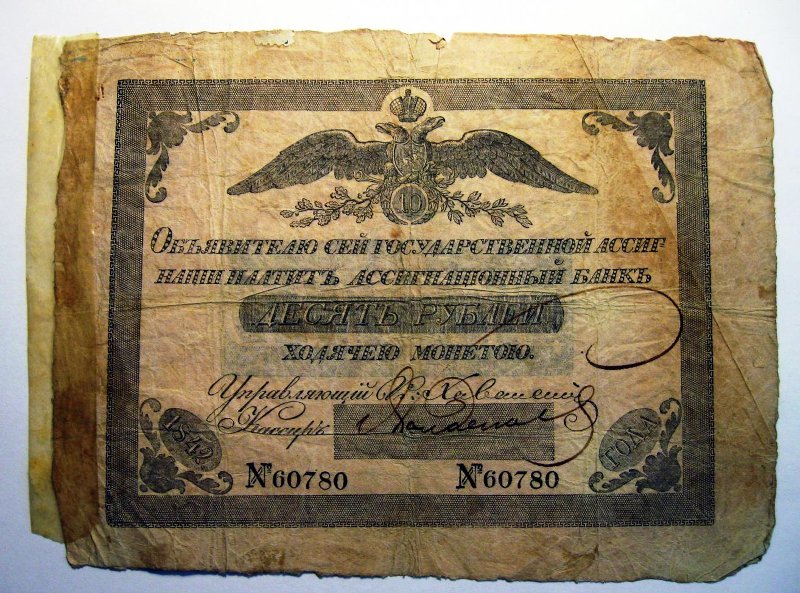
Russian Empire 10 Ruble Assignat, 1842 (1819-1843 Period)
The assignat features a prominent central vignette of the crowned double-headed eagle, the emblem of the Russian Empire, grasping a scepter and orb. On its chest is a shield with the numeral "10", surrounded by an olive wreath. The main text, "ОБЪЯВИТЕЛЮ СЕЙ ГОСУДАРСТВЕННОЙ АССИГНАЦІИ ПЛАТИТЬ АССИГНАЦІОННЫЙ БАНКЪ ДЕСЯТЬ РУБЛЕЙ ХОДЯЧЕЮ МОНЕТОЮ", is printed below the eagle, declaring the banknote's value. The design is framed by an ornate geometric and floral border with decorative corner elements. The year "1842" is integrated into an oval cartouche on the left side, mirroring a "ГОДА" (year) cartouche on the right. Below the main text are the handwritten signatures of the Manager and Cashier, and the serial number is repeated twice at the bottom. The overall aesthetic is typical of early 19th-century Russian assignats, prioritizing official authority and clarity.
Description
This is a 10 Ruble Assignat issued by the Russian Empire in 1842, falling within the 1819-1843 period. These assignats represent a crucial era in Russian monetary history, preceding the major financial reforms of Count Kankrin in 1839-1843, which aimed to stabilize the currency by withdrawing assignats and replacing them with state credit notes redeemable in silver. The design is characteristic of assignats from this period, featuring the imperial double-headed eagle with the denomination "10" on its chest. The assignat specifies that the Assignat Bank would pay "ten rubles in circulating coin" to the bearer. The presence of the explicit year "1842" and the signatures of "Управляющий В. Ховскій" and "Кассиръ Г. Ходановъ" provide important historical context and aid in cataloging. Serial number N° 60780 is clearly visible. Despite its worn condition, this banknote is a valuable historical artifact, offering insight into the financial system and printing techniques of the Russian Empire during the reign of Nicholas I, just before the abolition of the assignat system.