
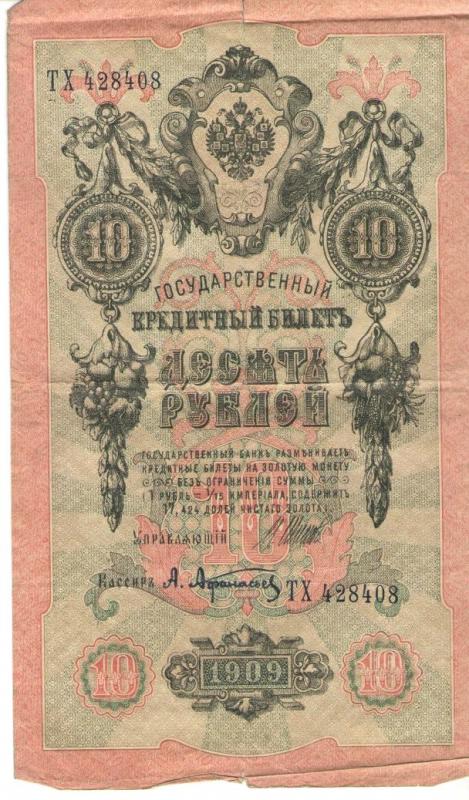
Russian Empire 10 Ruble Assignat, 1909 (State Credit Note, Shipov Signature)
The banknote features an elaborate design characteristic of late Imperial Russian currency. The central motif is the double-headed eagle of the Russian Empire, crowned and surrounded by ornate scrollwork and laurel branches. Denominational medallions ('10') are suspended on either side by ribbons and garlands. The typography is a blend of classical serifs and decorative scripts. The overall color scheme is a subtle interplay of pinkish-red for the borders and light green-grey for the central field, providing a sense of gravitas and officialdom.
Description
This is a historically significant 10 Ruble State Credit Note issued by the Russian Empire in 1909. Although referred to as an 'assignat' in the prompt's context, it is technically a 'Кредитный Билет' (Credit Note), distinct from earlier assignats. This banknote belongs to the series issued between 1898 and 1912, a period marked by the monetary reforms of Sergei Witte, which established the Russian ruble's gold convertibility. The note explicitly states: "The State Bank exchanges credit notes for gold coin without limitation of amount. 1 Ruble = 1/15 Imperial, contains 17.424 доли of pure gold." This guaranteed convertibility underscored the stability of the Imperial Russian currency before World War I. The obverse features the Imperial double-headed eagle crest at the top, flanked by medallions bearing the denomination "10". The design is rich with classical ornamentation, garlands, and ribbons. The serial number "ТХ 428408" is printed in the upper left and lower right corners. Below the main denomination, the year of issue "1909" is prominently displayed. The signatures of Director S.T. Shipov and Cashier A. Afanasyev authenticate the note. This piece represents a tangible link to Russia's economic policies and imperial grandeur in the early 20th century.