
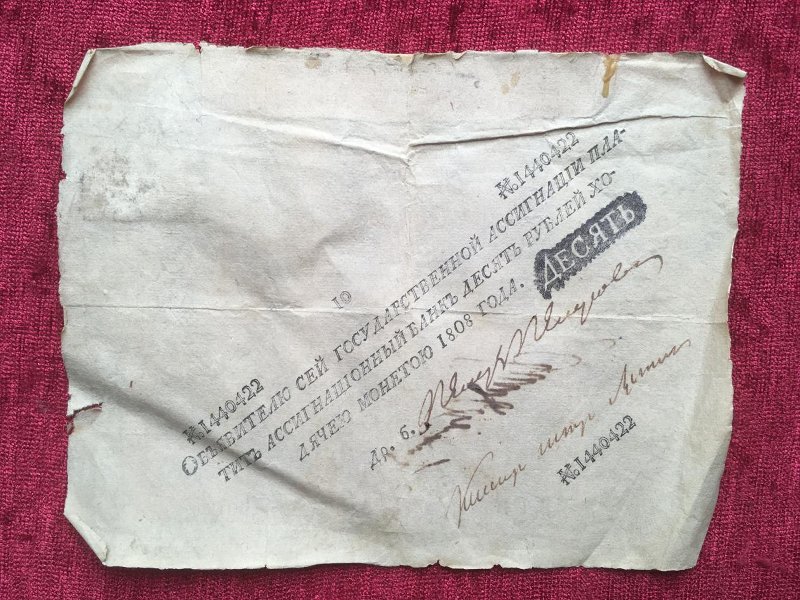
Russian Empire 10 Ruble Assignat, 1808 (1786-1819 Period)
The banknote features a utilitarian design characteristic of early Russian assignats. The central text declares the note's value and issuer. The denomination "ДЕСЯТЬ" (TEN) is boldly stamped within a rectangular box, a common feature for these notes. Serial numbers are printed, and handwritten signatures add authenticity. The design prioritizes legibility and security features of the time over elaborate artistic embellishments, typical for paper currency intended for wide circulation and practical use during a period of economic expansion and conflict.
Description
This is a 10 Ruble assignat issued by the Russian Empire in 1808. Assignats were paper money first introduced in Russia in 1769 and underwent several issues and reforms. The 1808 issue belongs to the second general period of assignats (1786-1819), which saw a significant increase in their circulation to finance wars (notably the Napoleonic Wars) and government expenditures. These notes were crucial for the Russian economy during this tumultuous period. The inscription "Объявителю сей Государственной Ассигнации платить Ассигнаціонный Банкъ ДЕСЯТЬ рублей ходячею монетою 1808 года" confirms its nature as a promissory note from the State Assignat Bank, guaranteeing payment in circulating coin. The handwritten signatures of Director Iv. Peshchurov and Cashier Petr Linin further authenticate the note. Despite its heavily circulated condition, this assignat represents a tangible piece of Russian monetary history, reflecting the challenges and economic policies of the early 19th century. Collectors value these notes for their historical significance and scarcity, especially in higher denominations or better preservation, as they played a vital role in the transition from metallic to paper currency.