
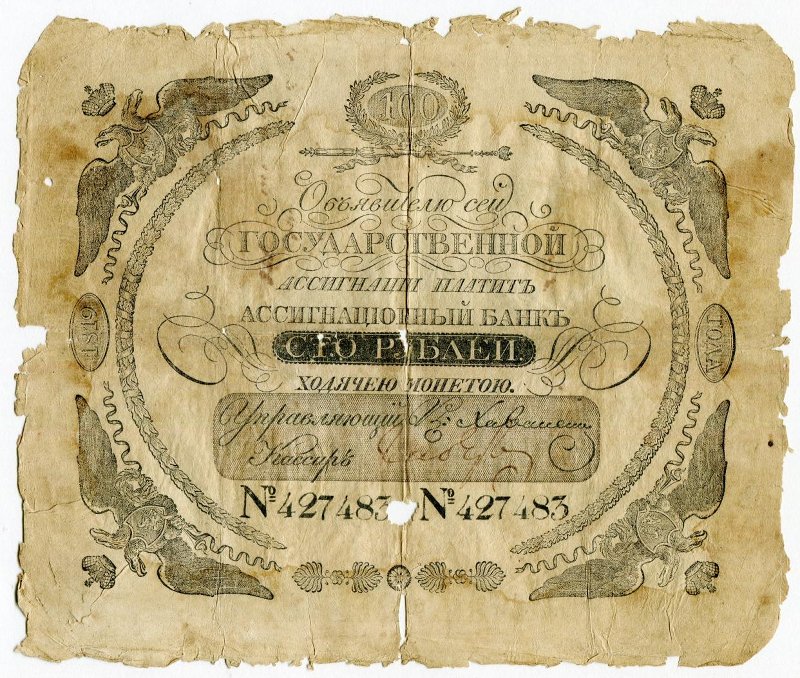
Russian Empire 100 Ruble Assignat, 1819 (1819 Series)
The banknote features an ornate central text block enclosed by a braided oval wreath. Four stylized double-headed eagles (the Imperial coat of arms) are positioned in the corners, flanking the wreath. The denomination '100' is presented within a small laurel wreath at the top center. The year '1819' is integrated into the left side of the oval frame, with 'ГОДА' (Year) on the right. Below the main text, there is a block for official signatures, and the serial number is prominently displayed at the bottom center. The overall design emphasizes state authority and financial promise, characteristic of Russian Empire assignats of this era.
Description
This is an important historical artifact: a 100 Ruble Assignat issued by the Russian Empire in 1819, falling into the 1819-1843 period of assignat circulation. Assignats were the primary form of paper money in Russia from 1769 to 1843, serving as a vital medium for financial transactions, especially after the Napoleonic Wars. This specific 100 ruble denomination was one of the higher values, playing a significant role in larger commerce. The design reflects the typical aesthetics of the era, featuring Imperial symbolism such as the double-headed eagles and a formal, promise-to-pay text: "Объявителю сеи Государственной Ассигнаціи платить Ассигнаціонный Банкъ СТО РУБЛЕИ ходячею монетою." (To the bearer of this State Assignat, the Assignat Bank shall pay ONE HUNDRED RUBLES in circulating coin.) The year 1819 marks the introduction of a new series of assignats during the reign of Emperor Alexander I, aimed at stabilizing the financial system after a period of inflation. Collectors often seek these assignats for their historical value, intricate design, and the tangible connection they offer to the monetary history of the Russian Empire. Despite its circulated condition, this banknote remains a testament to early Russian paper currency.