
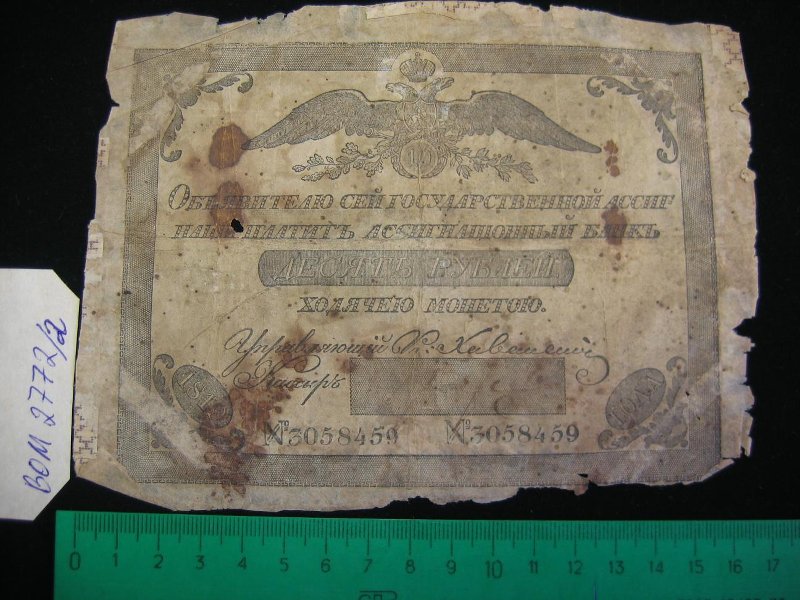
Russian Empire 10 Ruble Assignat, 1800 (1786-1819 Period)
The assignat features a classical rectangular design typical of early Russian paper money. The central motif is the Imperial double-headed eagle, crowned and holding a scepter and orb, with the numeral '10' on a shield on its breast. The text is in Old Russian script, surrounded by a decorative border with stylized floral elements in the corners, which also contain the stylized '10A' (10 Assignat) within oval frames. The overall style is monochromatic, printed in black/grey ink on light paper, emphasizing security features through engraving rather than complex color schemes.
Description
This is a 10 Ruble Assignat from the Russian Empire, representative of the issues circulating within the 1786-1819 period, though not bearing a specific printed year. This type of assignat, first authorized in 1786, played a crucial role in the Russian financial system, serving as state-issued paper money. The note prominently displays the Imperial double-headed eagle with the denomination '10' on its chest, surrounded by the legal tender declaration: 'The Bearer of this State Assignation Banknote shall be paid Ten Rubles in circulating coin.' (Объявителю сей Государственной Ассигнационной Банкъ имеетъ платить десять рублей ходячею монетою). The assignat carries the serial number N° 3058459 and features handwritten signatures of the 'Управляющий' (Manager), identified as A. Kavelin (А. Кавелинъ), and the 'Кассиръ' (Cashier), likely Barykov (Барыковъ). Despite its worn and stained condition, it remains a significant historical artifact, providing insight into the monetary policies and design aesthetics of the Russian Empire during a period of significant economic and political change.