
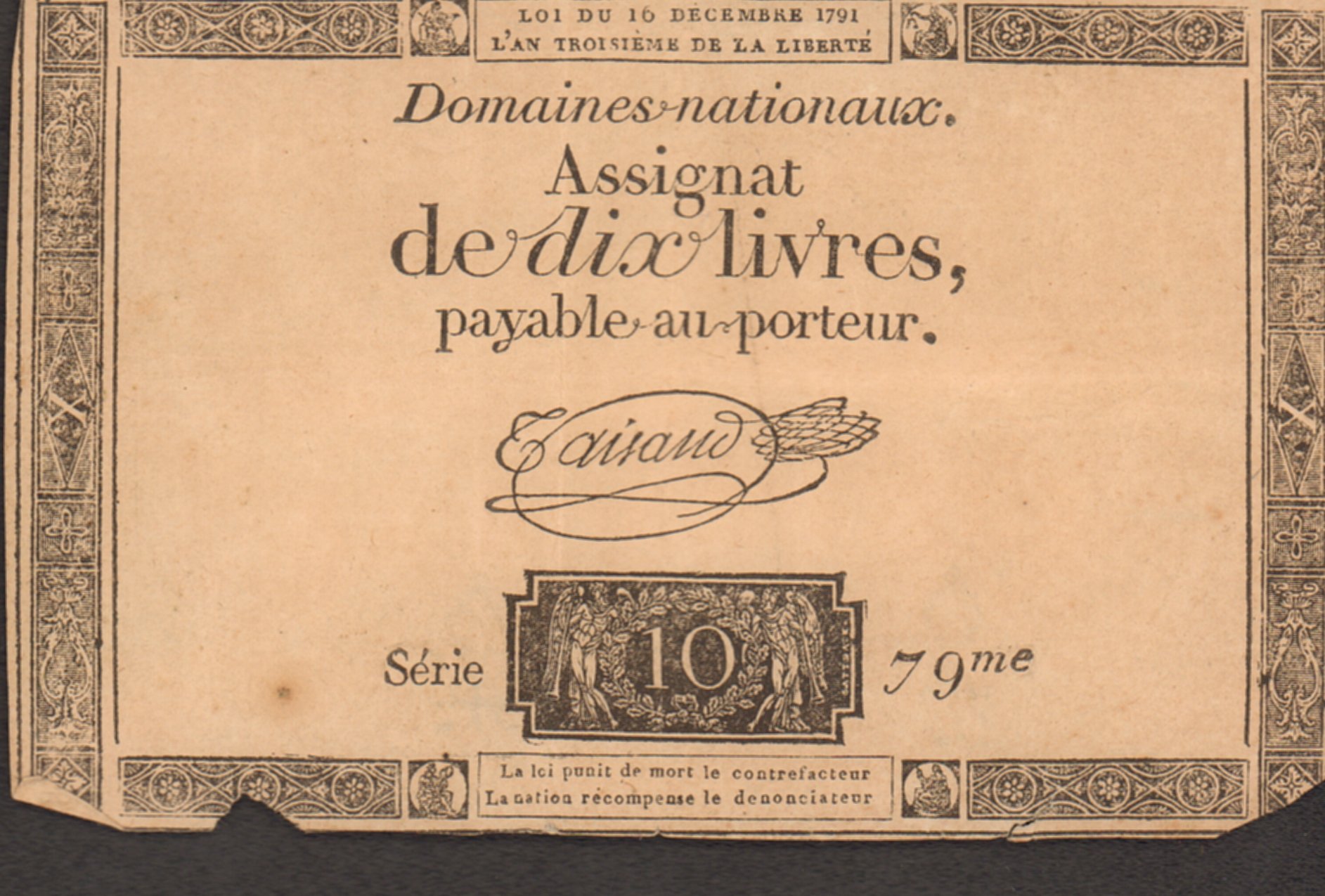
French Republic 10 Livres Assignat, 1791 (Law of 16 December 1791, Year III)
The assignat features a classical and somewhat austere design characteristic of the French Revolutionary period. It is printed in a monochromatic style (sepia/brownish ink on light paper). The central text is rendered in elegant, flowing script, conveying official gravitas. Decorative borders frame the banknote, featuring repetitive geometric and floral patterns, with small allegorical figures (possibly liberty caps or fasces) in the corners. The central denomination '10' is enclosed in an ornate rectangular frame, flanked by winged allegorical figures (likely genii or victories) holding wreaths. The overall aesthetic emphasizes order, authority, and revolutionary ideals.
Description
This is a 10 Livres Assignat issued by the French Republic during the tumultuous French Revolutionary Period. The banknote explicitly states "LOI DU 16 DECEMBRE 1791" (Law of December 16, 1791), which authorized this specific type of assignat. Below this, it reads "L'AN TROISIEME DE LA LIBERTE" (The Third Year of Liberty), corresponding to the period from September 22, 1794, to September 22, 1795, indicating the likely printing or issue date of this particular note under the earlier decree. Assignats were a form of paper money issued by the French Revolutionary government, initially as bonds backed by the value of confiscated church lands (biens nationaux, or 'Domaines nationaux' as seen on the note). However, over-issuance led to massive inflation and loss of confidence. The note declares "Assignat de dix livres, payable au porteur" (Assignat of ten livres, payable to the bearer). At the bottom, a stern warning states: "La loi punit de mort le contrefacteur La nation récompense le denonciateur" (The law punishes counterfeiters with death. The nation rewards the denunciator). The banknote belongs to "Série 79me" (79th Series), indicating its batch. The prominent signature is "Caissaud", likely representing an official of the *Caisse de l'Extraordinaire* (Fund of the Extraordinary), the institution responsible for their issuance.