
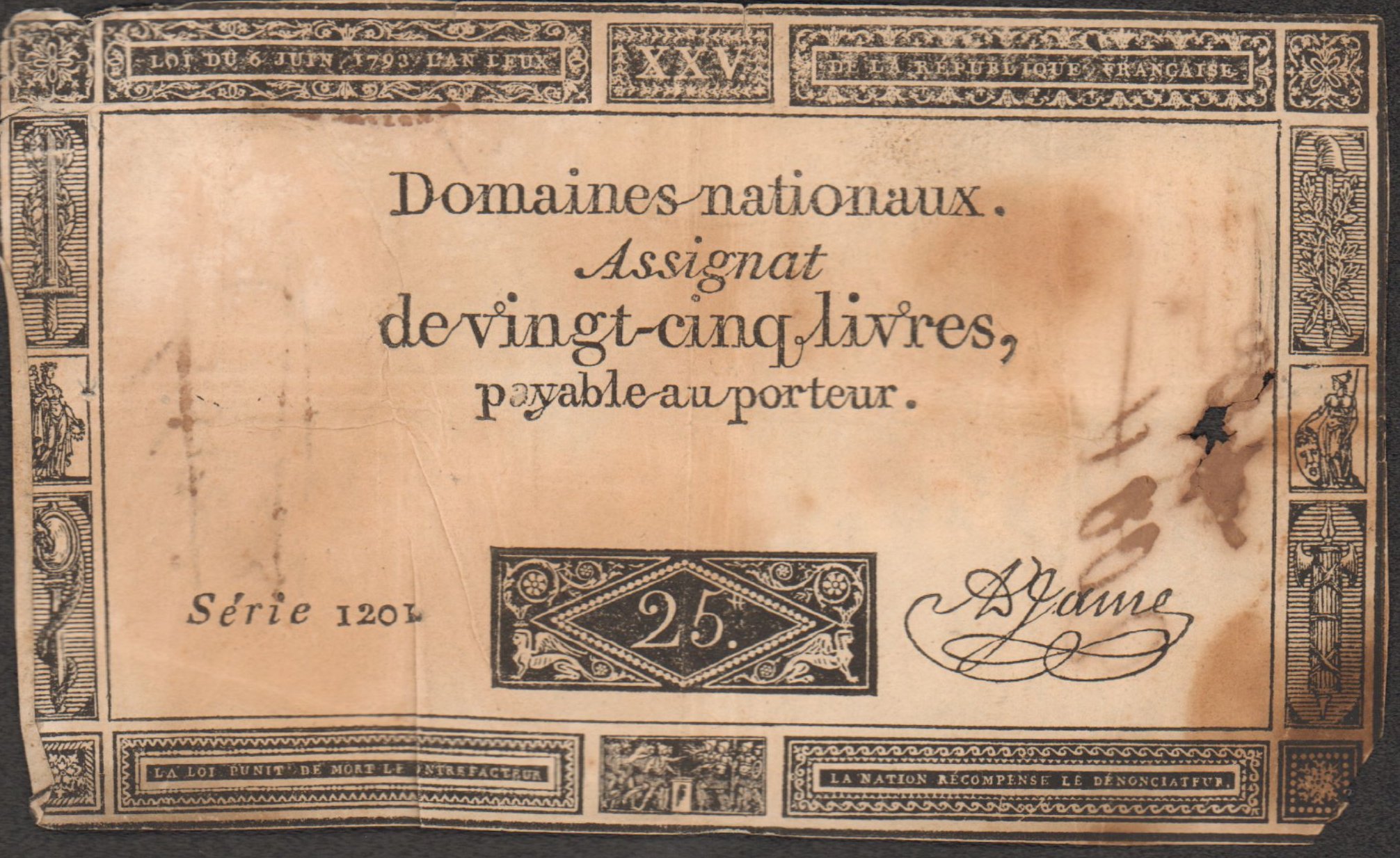
French Republic 25 Livres Assignat, 1793 (Law of June 6, 1793)
The assignat features a rectangular design with a decorative border. The central text is in clear, legible serif script, stating its purpose and denomination. The top border includes the date of the issuing law and the value 'XXV' flanked by decorative elements. The bottom border contains two mottoes: 'LA LOI PUNIT DE MORT LE CONTREFACTEUR' (The law punishes counterfeiters with death) and 'LA NATION RÉCOMPENSE LE DÉNONCIATEUR' (The nation rewards the informer), framing an allegorical scene. The left and right vertical borders have allegorical figures (e.g., Liberty, Justice) and symbols, such as fasces and a Phrygian cap on a pole. The central denomination '25' is enclosed in an ornate diamond-shaped cartouche. The overall style is characteristic of early revolutionary French paper money, often printed on relatively simple paper with security features limited to complex typography and border designs.
Description
This is a 25 Livres Assignat issued by the French Republic under the law of June 6, 1793 (Year II of the Republic). Assignats were a form of paper money issued by the French government during the French Revolution, initially as bonds backed by the value of confiscated church lands (biens nationaux), and later as general currency. This specific issue dates to a turbulent period of the Revolution, marked by the Reign of Terror. The note declares its backing by 'Domaines nationaux' (National Domains) and is payable to the bearer. The presence of strong warnings against counterfeiting and rewards for informers ('LA LOI PUNIT DE MORT LE CONTREFACTEUR' and 'LA NATION RÉCOMPENSE LE DÉNONCIATEUR') highlights the government's struggle with maintaining the currency's integrity and public trust. The note's design incorporates symbols of the Republic and revolutionary ideals. Collectors seek these notes for their historical significance, representing a critical monetary experiment during one of the most transformative periods in European history.