
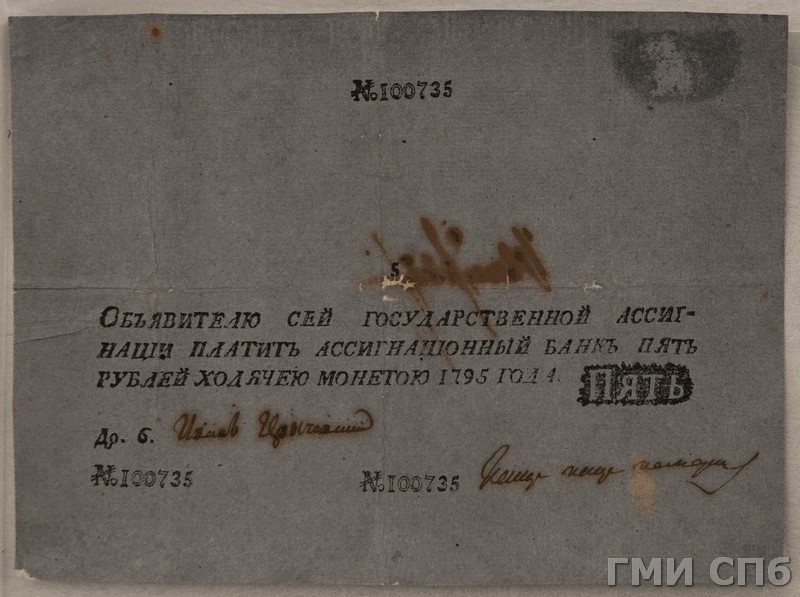
Russian Empire 5 Ruble Assignat, 1795 (1786-1819 Period)
This 5 ruble assignat from the Russian Empire features a minimalist and functional design typical of early paper currency. Printed on grey paper with dark brown/black ink, it prioritizes legibility of its textual content over elaborate artistic elements. The central promise of payment, "ОБЪЯВИТЕЛЮ СЕЙ ГОСУДАРСТВЕННОЙ АССИГНАЦІИ ПЛАТИТЬ АССИГНАЦІОННЫЙ БАНКЪ ПЯТЬ РУБЛЕЙ ХОДЯЧЕЮ МОНЕТОЮ 1795 ГОДА" (To the bearer of this State Assignat, the Assignat Bank shall pay Five Rubles in circulating coin of the year 1795), is centrally positioned. The denomination "ПЯТЬ" (FIVE) is also highlighted in a decorative, rectangular frame on the right side. The serial number "N° 100735" appears prominently at the top center and is repeated below the signatures on the bottom left and right, serving as a security feature. The simplicity of design reflects the early stages of paper money issuance in the Russian Empire, where security primarily relied on paper quality, watermarks (not visible in this image), and authentic signatures rather than complex engraving.
Description
This Russian Empire 5 Ruble Assignat, issued in 1795, represents a significant piece of numismatic history from the late 18th century. Assignats were the first paper currency introduced in Russia, initially in 1769 under Catherine the Great, as a means to alleviate the shortage of silver and copper coinage and to fund state expenses. The 1795 issue falls within the second period of assignat issuance (1786-1819), a time of continued expansion of paper money to meet the demands of a growing empire and military campaigns. This particular assignat promises the bearer five rubles in circulating coin, reflecting its nature as a promissory note rather than intrinsic value currency. The serial number N° 100735, printed multiple times, served as a security measure against counterfeiting. The presence of two handwritten signatures, identified as 'Иванъ Управляющій' (Ivan Manager) and 'Кассиръ Петръ Поляковъ' (Cashier Pyotr Polyakov), further authenticates the note. These early assignats are highly collectible due to their historical significance, connection to imperial Russia, and the challenges faced by the Russian monetary system during this era. Despite its worn condition, with visible folds, creases, minor tears, and prominent central brown staining, this banknote offers a tangible link to the economic and financial history of the Russian Empire. Collectors often seek these notes for their historical context and the unique insight they provide into early paper currency.