
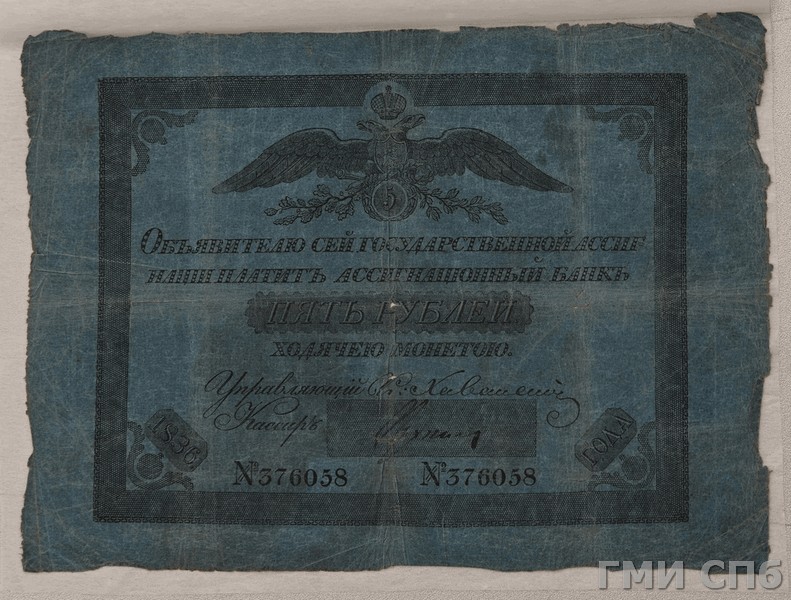
Russian Empire 5 Ruble Assignat, 1838 (1819-1843 Period)
The banknote features a monochrome blue print on light paper, giving it a distinctive blue appearance. The central design prominently displays the Imperial Russian double-headed eagle at the top, holding a scepter and an orb, with the denomination '5' enclosed in a circular shield on its chest. Below the eagle is the main promissory text in Old Cyrillic. The note is framed by an intricate geometric border pattern. The year '1838' is clearly visible in a stylized oval stamp in the lower-left corner, mirrored by a 'ГОДА' (Year) stamp in the lower-right.
Description
This is a historical 5 Ruble Assignat from the Russian Empire, issued in 1838. Assignats were the first form of paper money in Russia, introduced in 1769. This particular note belongs to the general issue series of 1819-1843, a period marked by attempts at financial stabilization under Emperor Nicholas I, although the value of paper currency often fluctuated against silver. The note's design features the powerful Imperial double-headed eagle, a symbol of the Russian state, with the denomination '5' centrally placed on its chest. The main inscription declares the obligation of the Assignat Bank to pay 'Five Rubles in circulating coin' to the bearer. The distinct '1838' year stamp in the lower-left corner precisely dates its issue. The serial number 'Nº 376058' is repeated at the bottom. Handwritten signatures of the Manager (Управляющiй) S.Kh. Veselik and Cashier (Кассиръ) Pepyan are present, which are important details for collectors due to variations in signature combinations. Despite its heavily circulated state, characterized by extensive creasing, significant edge wear, and discoloration, this assignat remains a compelling artifact of Russian monetary history, offering valuable insights into the financial landscape and early paper currency system of the 19th-century Russian Empire.