
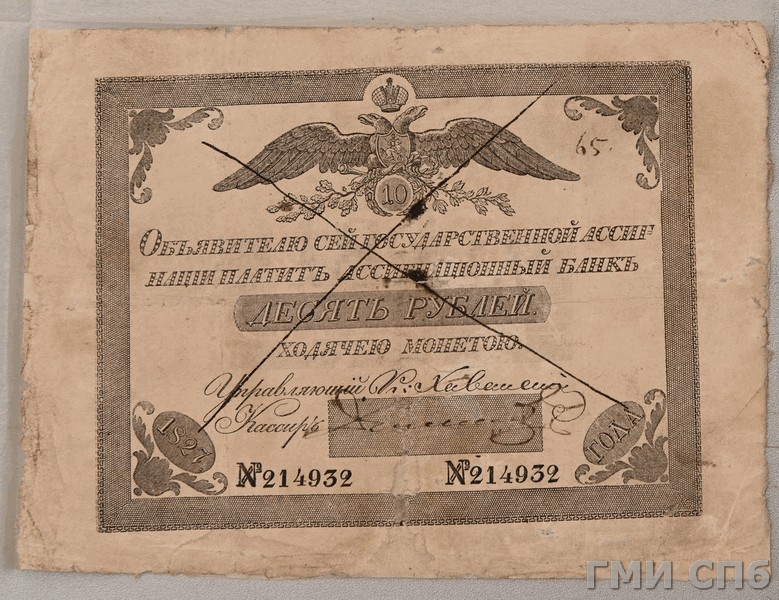
Russian Empire 10 Ruble Assignat, 1827 (1819-1843 Period)
The assignat features a classic design for Russian imperial banknotes of the era. The central motif is the double-headed Imperial Eagle crowned, holding a scepter and orb, with the denomination '10' on its chest shield. The main text states the promise to pay 'TEN RUBLES in current coin' to the bearer. The note is framed by an intricate decorative border comprising geometric and floral patterns. The year '1827' is prominently displayed in an oval cartouche in the bottom-left corner, balanced by 'ГОДА' in a similar cartouche on the right. Serial numbers are placed symmetrically at the bottom. The overall aesthetic is monochrome, typical of early paper currency designed for security through intricate line work rather than color.
Description
This is a 10 Ruble Assignat issued by the Russian Empire in 1827, falling within the 1819-1843 period of assignat issuance. These notes were a form of paper money, effectively government bonds, first introduced in Russia in 1769, and played a crucial role in the financing of the state. The design prominently features the Imperial double-headed eagle, a symbol of Russian sovereignty, along with the promise of payment by the Assignat Bank. The note bears the signatures of 'Управляющий' (Manager) R. Khovelets (Р. Ховелецъ) and an illegible 'Кассиръ' (Cashier). The serial number '№ 214932' appears twice at the bottom. This specific assignat, dated 1827, is part of a series that underwent several design and security feature changes over its long period of circulation. Assignats from this era are historically significant, representing a transitional period in Russian monetary policy before the financial reforms of the mid-19th century. The diagonal ink marks across the face indicate that the note was officially cancelled or redeemed, a common practice to prevent recirculation.