
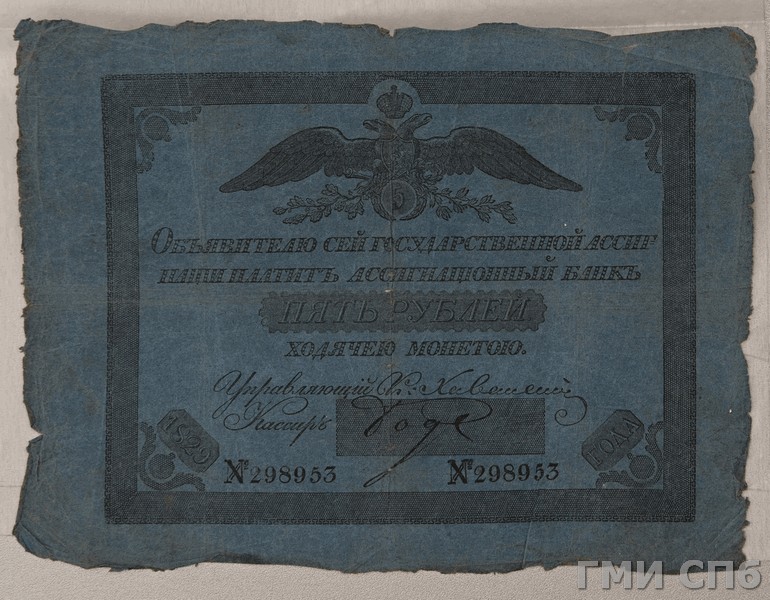
Russian Empire 5 Ruble Assignat, 1829 (1819-1843 Period)
The assignat features a classical and austere design typical of Russian paper currency of the early 19th century. Printed in blue ink on blue paper, it showcases the double-headed Imperial Russian eagle at the top, crowned and holding a scepter and orb. The central text is enclosed within a fine geometric and scrollwork border, with stylized corner embellishments. The typography is clear Cyrillic, with larger script for the denomination. The overall style emphasizes state authority and functionality over elaborate artistic flourishes.
Description
This is a 5 Ruble assignat issued by the Russian Empire in 1829. Assignats were a form of paper money used in Russia from the late 18th century until the mid-19th century. This particular note belongs to the series issued during the reign of Emperor Nicholas I (1825-1855), falling within the 1819-1843 period of assignat circulation. The blue color was standard for the 5-ruble denomination, aiding in quick identification. The obverse prominently displays the double-headed eagle of the Russian Imperial coat of arms, symbolizing the state's authority. The central inscription states: 'Объявителю сей Государственной Ассигнации платить Ассигнационный Банкъ ПЯТЬ РУБЛЕЙ ходячею монетою' (To the bearer of this State Assignat, the Assignat Bank shall pay FIVE RUBLES in circulating coin). Key identification features include the year '1829' in an oval frame on the lower left, and the serial number 'Nº 298953' repeated at the bottom. It bears the handwritten signatures of the 'Управляющий' (Manager/Director) V. Kavelin and 'Кассиръ' (Cashier) Pod'e. Despite its circulated condition, this assignat represents a significant piece of Russian monetary history, illustrating the currency system of the Empire during a pivotal period.