
Coins of the USSR: Key Types and Price Levels
Numismatics of the Soviet period covers a vast layer of history, reflected in metal money from 1921 to 1991. These coins are not only means of payment of their era, but also valuable artifacts that tell about the political, economic and cultural changes in the USSR. Interest in them is fueled by both the availability of mass issues and the presence of real rarities, the cost of which can reach hundreds of thousands of rubles.
February 1, 2026
Edited by Administrator 2/1/2026
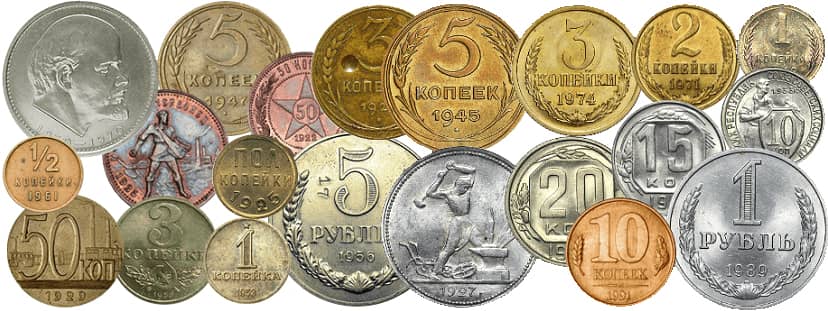
Introduction to Numismatics of the Soviet Period
Numismatics of the Soviet period covers a vast layer of history, reflected in metal money from 1921 to 1991. These coins are not only means of payment of their era, but also valuable artifacts that tell about the political, economic and cultural changes in the USSR. Interest in them is fueled by both the availability of mass issues and the presence of real rarities, the cost of which can reach hundreds of thousands of rubles.
For a novice collector, the world of Soviet coins may seem complicated, but it can be systematized. Understanding the main categories, knowing the rare years, and being able to assess the condition of the coin are the three pillars on which successful collecting is built. Each coin, from a simple kopeck to a jubilee ruble, holds a piece of the past, which makes their search and study a fascinating process.
Main Types of Soviet Coins
All coins issued in the Soviet Union can be conditionally divided into several main categories, each of which is of interest to collectors. Knowing this classification helps to systematize the collection and determine its value.
Key types of coins of the USSR:
- Coins of regular mintage. These are the most common coins that were used in everyday circulation. Their cost, as a rule, is low, with the exception of coins of rare years of issue or with certain varieties of dies.
- Jubilee and commemorative coins. They were issued in limited editions in honor of significant events, dates or personalities. The first such coin appeared in 1965. They almost did not participate in circulation and often have a good state of preservation.
- Trial coins. These are the rarest and most expensive specimens. They were minted in the process of developing a new design or alloy and never went into circulation. There are known single copies that are the pearls of any numismatic collection.
Rare Issues and Their Estimated Cost
| Rare coin | Description | Approximate cost (in rubles) |
| Set of coins of 1947 | The circulation was almost completely destroyed, single copies have been preserved | High auction price, from several million |
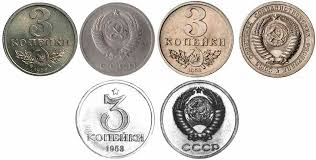
| Set of coins of 1958 | The circulation did not go into circulation, part was used to configure vending machines | From 70 000 to 500 000 per coin |
| 2 kopecks 1925 | One of the rarest coins of regular mintage of the early USSR | From 60 000 to 150 000 |
| 20 kopecks 1934 (old coat of arms) | Die shift, very rare variety | From 100 000 and above |
The value of a Soviet coin is largely determined by its rarity. Some years of issue are considered legendary among numismatists, since almost the entire circulation of these coins was destroyed or did not go into circulation. Such specimens are the main goal for serious collectors.
Of particular interest are the coins of 1947 and 1958. The coins of 1947 were minted, but almost the entire circulation was sent for remelting due to the discrepancy between the coat of arms and the new number of republics. The coins of 1958 were issued as part of preparations for the monetary reform, which was postponed, and most of the circulation was also destroyed.
Key Factors Affecting Price
| State of preservation | Description |
| UNC (Uncirculated) | Perfect condition, the coin has not been in circulation, has an original mint luster. |
| XF (Extremely Fine) | Excellent condition, minimal, barely noticeable abrasions on the most prominent parts of the relief. |
| VF (Very Fine) | Very good condition, the coin was in circulation, but retained all the fine details of the drawing. |
| F (Fine) | Good condition, noticeable abrasions, about half of the small details of the relief are erased. |
The value of a collectible coin is not a fixed value, it depends on the combination of several important factors. The ability to correctly assess them allows you to determine the real market price of a specimen and avoid overpayments when buying or losses when selling.
Three main evaluation criteria:
- Year of issue and circulation. The basic principle is simple: the fewer coins were minted, the more valuable they are. That is why coins of certain years, such as 1947 or 1958, are so expensive.
- State of preservation. The condition of the coin (grade) is one of the most important pricing factors. A coin that has not been in circulation can cost dozens or even hundreds of times more than its analogue with traces of wear.
- Varieties and minting errors. Seemingly insignificant details, such as features of the drawing, the shape of the letters or errors (die shifts, double strikes), can drastically increase the value of the coin.
The international Sheldon grading system is used to assess the condition of coins.
Comments (0)
No comments yet. Be the first to share your thoughts!