
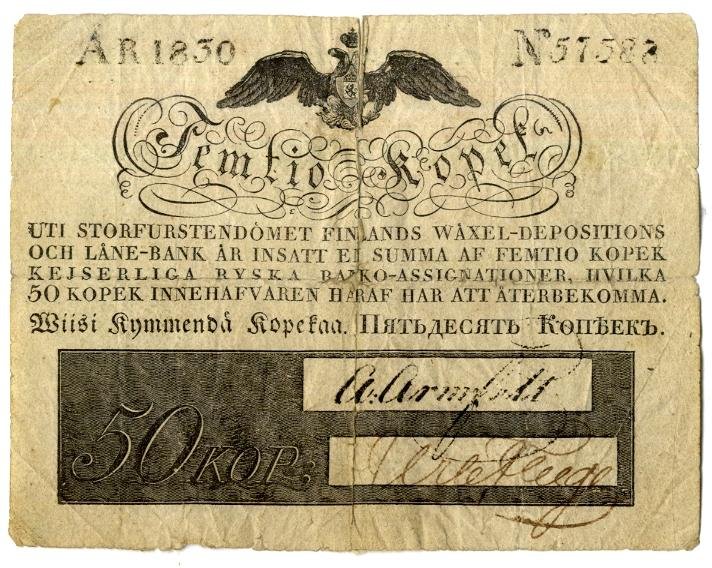
Russian Empire 50 Kopek Assignat, 1830 (Grand Duchy of Finland Issue)
Russian Empire
1830
1819-1843
50
N° 57582
Style
The assignat features a classical, somewhat ornate design typical of early 19th-century European banknotes. The top center is dominated by the Imperial Russian double-headed eagle emblem, crowned, holding an orb and scepter, signifying the Russian Empire's authority over Finland. The denomination 'Femtio Kopek' is rendered in elaborate calligraphic script. Below this, the explanatory text is presented in a serif font, primarily in Swedish (as Finland was historically part of Sweden and Swedish was an official language) and then repeated in Old Russian (Cyrillic). The bottom left features a large, stylized '50 KOP' in a decorative, almost shadowed font within a dark rectangular frame. To its right are two blank rectangular spaces for handwritten signatures, indicating official authorization. The overall design emphasizes security through detailed typography and official symbolism rather than complex illustrations or multiple colors, which was common for assignats of this era.
Description
This is a 50 Kopek assignat issued in 1830 by the Imperial Russian government for circulation in the Grand Duchy of Finland. These notes were part of a series of 'Wäxel-Depositioner' (Exchange-Deposit notes) issued by the Exchange, Deposit, and Loan Bank (Wäxel-Deposition och Låne-Bank) in Finland, which was under Russian rule since 1809. The note's value is stated in both Swedish ('Femtio Kopek') and Old Russian ('Пятьдесятъ Копѣекъ'), reflecting the linguistic context of the Grand Duchy. The central text confirms that a sum of 50 Kopeks in Imperial Russian bank assignations has been deposited in the bank, and the bearer is entitled to receive it back. The Imperial double-headed eagle at the top clearly indicates Russian sovereignty. This specific assignat falls within the 1819-1843 period of Russian assignat issues and is a key piece for collectors interested in Russian financial history, especially its administration of Finland. The low denomination assignats are often harder to find in good condition due to their extensive use in daily commerce.