
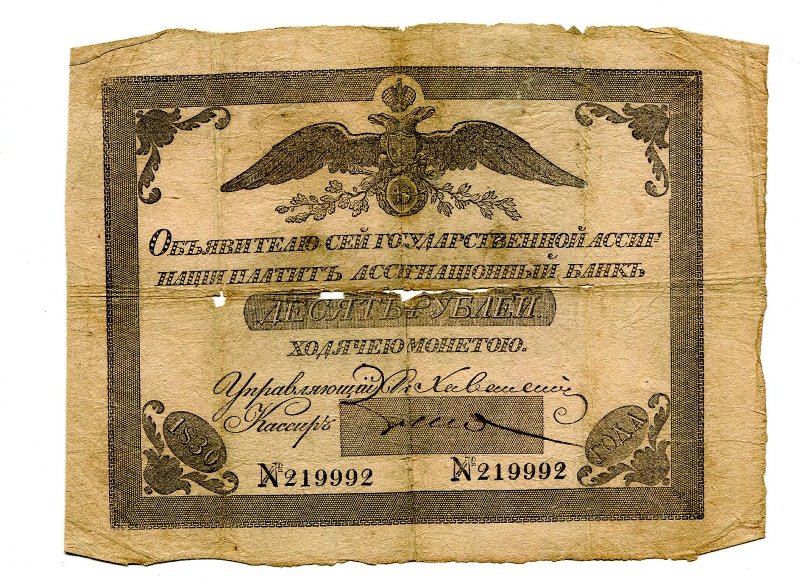
Russian Empire 10 Ruble Assignat, 1830 (1819-1843 Period)
Russian Empire
1830
1819-1843
10
№ 219992
Style
The assignat features a classic Russian Empire design from the early 19th century. The central motif is the Imperial double-headed eagle, crowned and holding a scepter and orb, with the image of Saint George slaying the dragon on a shield on its chest, surrounded by an oak wreath. The denomination 'ДЕСЯТЬ РУБЛЕЙ' (TEN RUBLES) is prominently displayed within an oval cartouche. The note is framed by an ornate border with intricate geometric patterns and decorative floral flourishes in the corners. The year '1830' is noted in the lower-left corner cartouche, balanced by 'ГОДА' (YEAR) in the lower-right corner. The overall aesthetic is characteristic of Russian financial documents of the era, emphasizing imperial authority and state backing.
Description
This is a 10 Ruble assignat from the Russian Empire, issued in 1830, belonging to the series of assignats circulated between 1819 and 1843. These notes were a crucial part of Russia's monetary system following the Napoleonic Wars, serving as paper currency backed by the state treasury. The front features the iconic Imperial double-headed eagle, symbolizing the might and authority of the Russian Empire. The text "ОБЪЯВИТЕЛЬ СЕЙ ГОСУДАРСТВЕННОЙ АССИГНАЦИИ ПЛАТИТЬ АССИГНАЦИОННЫЙ БАНКЪ ДЕСЯТЬ РУБЛЕЙ ХОДЯЧЕЮ МОНЕТОЮ" (The bearer of this state assignat is to be paid by the Assignat Bank Ten Rubles in current coin) indicates its function as a promissory note. The signatures of the 'Управляющий' (Manager/Director) Р. Кавелинъ and a faded 'Кассиръ' (Cashier) are visible below the denomination. The serial number N° 219992 is printed twice at the bottom. The 1830 issue is significant as it falls within a period of monetary stabilization efforts in Russia. Despite its worn condition, this assignat is a tangible piece of Russian financial history, illustrating the design and administrative practices of the era. Collectors are drawn to these early paper currencies for their historical context and artistic design.