
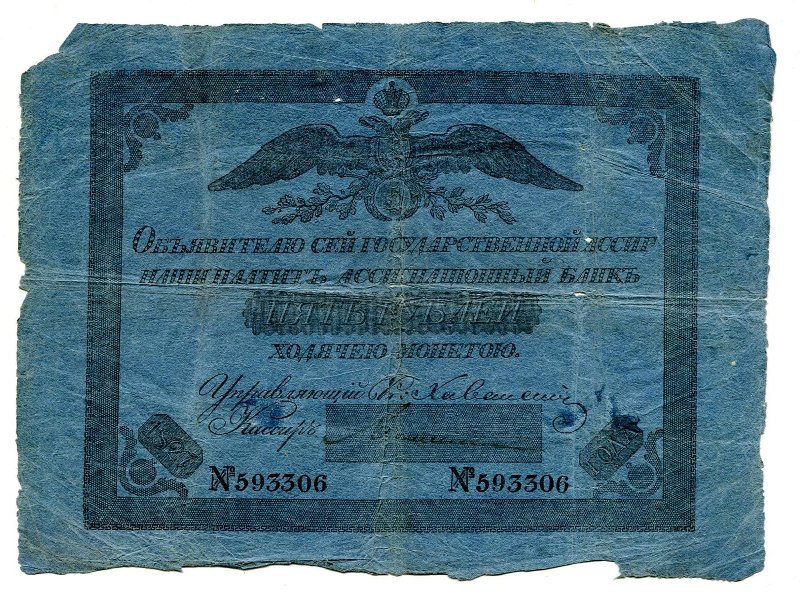
Russian Empire 5 Ruble Assignat, 1802 (1786-1819 Series)
Russian Empire
1802
1786-1819
5
N° 593306
Style
The banknote features a monochrome blue print on paper, characteristic of Russian assignats of this era. The central motif is the Imperial double-headed eagle, crowned, with wings outstretched, holding laurel and oak branches in its talons. A shield with an obscured monogram (likely of the reigning monarch, Catherine II or Alexander I) is on its breast. The main text is prominently displayed, stating the note's value and the issuing authority. Decorative elements include ornate borders and corner embellishments with the denomination '5' indicated in a stylized way within ovals.
Description
This is a historic 5 Ruble Assignat from the Russian Empire, part of the extensive issue series circulating between 1786 and 1819. These assignats were early forms of paper money in Russia, introduced to cover state expenditures and facilitate trade. The blue color specifically designated the 5 Ruble denomination during this period, helping to distinguish it from other values (e.g., 10 Rubles were red, 25 Rubles were yellow). The note features the Imperial double-headed eagle, a symbol of Russian sovereignty. The text "Объявителю сей Государственной Россійской Ассигнаціонный Банкъ платитъ ПЯТЬ РУБЛЕЙ ходячею монетою" translates to "To the bearer of this State Russian Assignation Bank pays FIVE RUBLES in circulating coin," indicating its status as legal tender. The specific year 1802 is often associated with this type of 5 Ruble assignat within the broader 1786-1819 series, particularly during the reign of Emperor Alexander I, when these notes saw wide circulation. This piece offers valuable insight into the monetary history and economic policies of the Russian Empire in the late 18th and early 19th centuries.