
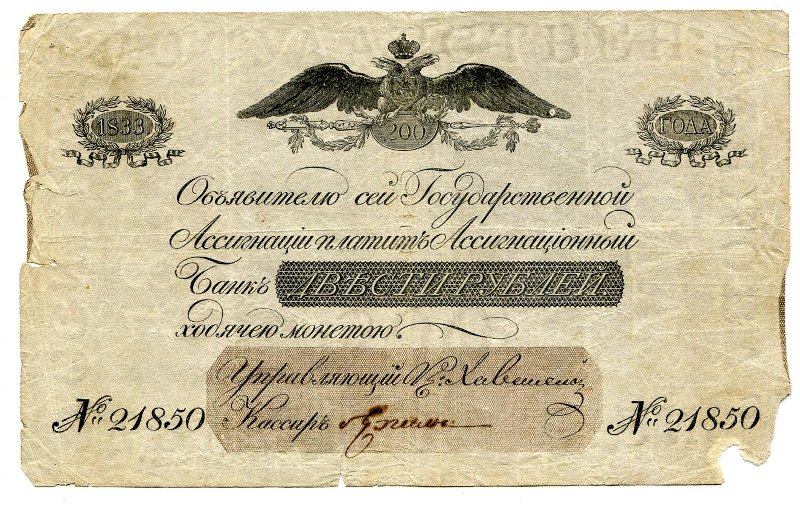
Russian Empire 200 Ruble Assignat, 1833 (1819-1843 Period)
Russian Empire
1833
1819-1843
200
№ 21850
Style
The banknote features a classic design for Russian Empire assignats of the period. At the top center, the Imperial double-headed eagle, crowned and holding a scepter and orb, is prominently displayed, with the denomination '200' on a shield on its chest. Flanking the eagle are two oval wreaths; the left one contains the year '1833', and the right one has the word 'ГОДА' (year). The central text, written in elegant calligraphic script, promises payment: 'Объявителю сей Государственной Ассигнации платитъ Ассигнационной Банкъ ДВЕСТИ РУБЛЕЙ ходячею монетою.' (The bearer of this State Assignat is paid by the Assignat Bank Two Hundred Rubles in current coin.) The denomination 'ДВЕСТИ РУБЛЕЙ' is further emphasized within a hatched rectangular frame. The serial number '№ 21850' is printed in decorative script in both lower corners. The lower central section contains a hatched rectangle where the handwritten signatures of the Manager and Cashier are placed.
Description
This is a 200 Ruble Assignat issued by the Russian Empire in 1833. Assignats were the first form of paper money introduced in Russia, first appearing in 1769. This specific note belongs to the third major issue of Russian Assignats (1819-1843), a period marked by attempts to stabilize the national currency after the extensive expenditures of the Napoleonic Wars. The design incorporates key elements symbolizing state authority and financial promise, including the Imperial double-headed eagle and the explicit statement that the bearer would be paid in 'current coin' by the Assignat Bank. The high denomination of 200 rubles indicates its significant purchasing power at the time. This particular banknote bears the authentic signatures of the Manager (Управляющiй) A. Havelets and the Cashier (Кассиръ) Gunin, which are crucial for historical authenticity and cataloging. Despite its circulated condition, showing clear signs of age and handling like folds, softened edges, minor tears, and overall toning, the printed details and handwritten signatures remain largely legible. It represents a valuable historical artifact for numismatists and collectors interested in the monetary history of the Russian Empire, offering insights into early paper currency and the economic policies of the era.