
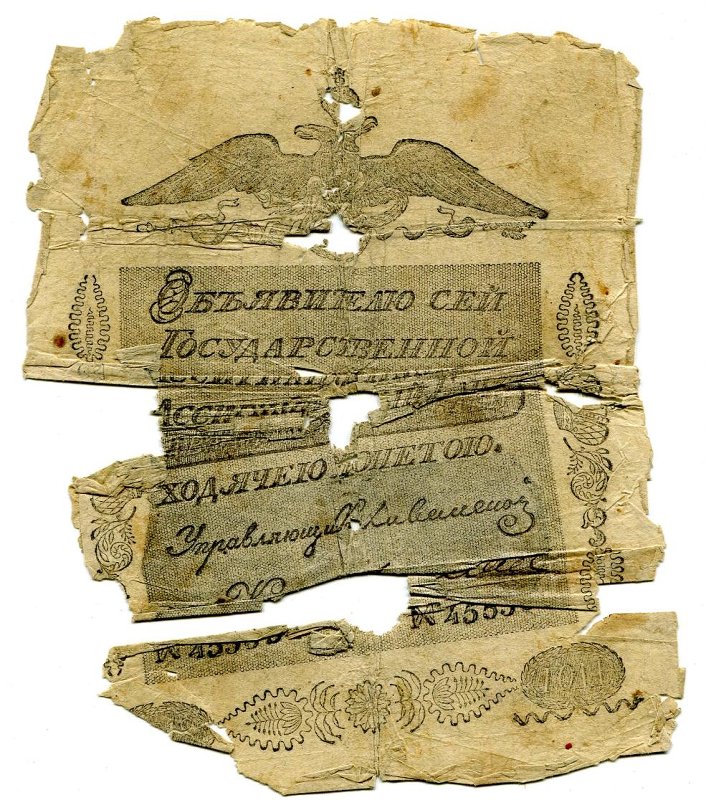
Russian Empire 100 Ruble Assignat, 1800 (1786-1819 Period)
Russian Empire
1800
1786-1819
100
N° M 4505
Style
The assignat features a prominent Imperial double-headed eagle at the top, signifying state authority. The central field contains Cyrillic text declaring the note as legal tender. Ornate borders with rococo-style scrolling patterns and geometric designs frame the central text and extend along the sides and bottom. The denomination is indicated in an oval frame. The overall design is monochromatic (black print on light paper), typical for assignats of this era.
Description
This is a rare and historically significant fragment of a 100 Ruble Assignat from the Russian Empire, likely issued around 1800 as part of the broader 1786-1819 period of assignat issuance. Assignats were the first form of paper money introduced in Russia, initially in 1769 under Catherine the Great. This particular denomination and design, featuring the double-headed Imperial eagle and the declaration of being a 'Государственной Ассигнаціи' (State Assignat) and 'ходячею денетою' (legal tender), is characteristic of issues from the early 19th century. The serial number 'N° M 4505' suggests it belongs to a specific series (the 'M' series was used for 100 Ruble notes around 1800-1806). A partial title of 'Управляющий' (Manager) is visible below the central text, indicating the signing official. Despite its extremely poor and fragmented condition, with significant paper loss, tears, creases, and discoloration, it remains an important artifact for numismatists and historians, offering a tangible link to Russia's early paper currency system and the financial challenges of the era. Its value lies primarily in its historical rarity and the information it conveys about early Russian monetary policy.