
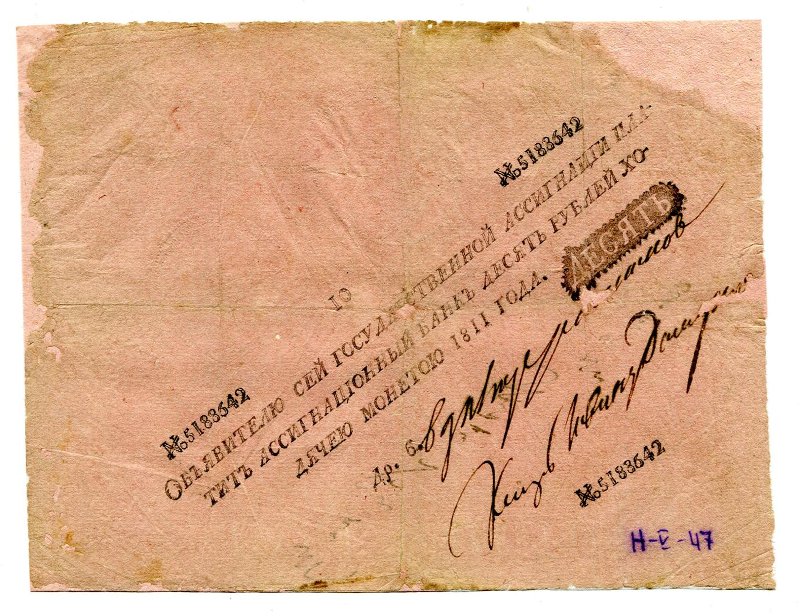
Russian Empire 10 Ruble Assignat, 1811 (1786-1819 Period)
Russian Empire
1811
1786-1819
10
№ 5183642
Style
The assignat exhibits a simple, functional design typical of early Russian paper currency, primarily focused on textual information. The provided image shows the reverse side, characterized by a prominent declaration of value and promise to pay by the State Assignat Bank, dated 1811. The text is printed in black ink, diagonally placed to prevent counterfeiting or alteration. A distinct oval stamp with 'ДЕСЯТЬ РУБЛЕЙ' (TEN RUBLES) reinforces the denomination. The paper is thick, lacking elaborate decorative elements often found on the obverse of such notes. The overall impression is one of austerity, emphasizing the financial instrument's purpose rather than artistic embellishment.
Description
This is a reverse side of a 10 Ruble Assignat issued by the Russian Empire in 1811, belonging to the 1786-1819 period of assignat issuance. The note clearly states: 'Объявителю СЕЙ ГОСУДАРСТВЕННОЙ АССИГНАЦІИ ПЛАТИТЬ АССИГНАЦІОННЫЙ БАНКЪ ДЕСЯТЬ РУБЛЕЙ ХОДЯЧЕЮ МОНЕТОЮ 1811 ГОДА.' (To the bearer of THIS STATE ASSIGNAT, the ASSIGNAT BANK SHALL PAY TEN RUBLES IN CURRENT COIN OF 1811.) The serial number № 5183642 is prominently displayed three times diagonally across the note. The denomination 'ДЕСЯТЬ РУБЛЕЙ' is also stamped in a decorative oval. Key signatures include that of 'Др.' (Director) 'Князь Иванъ Долгорукой' (Prince Ivan Dolgoruky), a prominent figure during that era. Another, less legible signature is present above Dolgoruky's, likely a cashier or senior official. This assignat reflects a critical period in Russian financial history, marked by extensive issuance of paper money to cover war expenses and state deficits, particularly during the Napoleonic Wars. Collectors value these notes for their historical significance and the insight they provide into the monetary system of Imperial Russia.